How Parents Can Help Their Child Play Soccer Without Being The Coach
Aug 27, 2026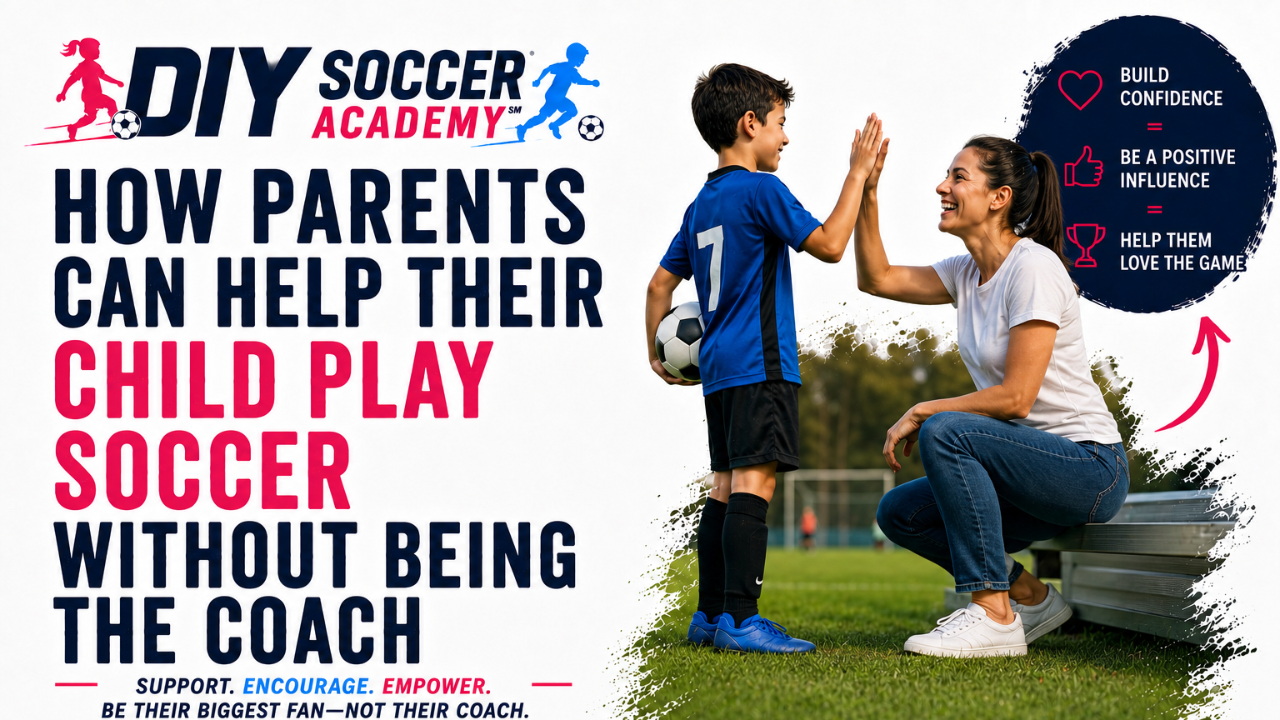
How Parents Can Help Without Being the Coach
Published by DIY Soccer Academy
Youth soccer is about more than learning how to pass, dribble, shoot, or score. For young players, it is also about building confidence, learning how to handle mistakes, developing independence, and discovering a love for the game.
As a parent, you play an important role in that development—but you don't have to become your child's coach.
In fact, one of the best things you can do for your child's soccer development is support their training without taking over their training.
The goal isn't to tell your child everything they should do. It's to create an environment where they feel encouraged to learn, practice, make mistakes, and grow.
You Don't Have to Be a Soccer Expert
One of the biggest misconceptions parents have is that they need to understand soccer tactics or have extensive playing experience to help their child.
You don't.
Your role is less about teaching technical skills and more about supporting the habits that help your child improve.
You can help by:
- Making time for practice
- Providing a ball and a safe space to train
- Encouraging consistency
- Celebrating effort and improvement
- Asking questions
- Helping your child stay motivated
- Giving them space to learn independently
Your child doesn't need another coach standing next to them.
They need a parent who believes in them.
Let Coaches Coach
If your child plays on a team, there is already a coach responsible for teaching the game, organizing practices, and helping players understand their role.
Try to let the coach do that job.
It's easy to watch from the sideline and want to give instructions:
"Pass it!"
"Shoot!"
"Go left!"
"Get back!"
But when players hear instructions from multiple adults, it can become confusing and overwhelming.
Instead, allow your child's coach to provide the soccer instruction while you focus on being their biggest supporter.
That doesn't mean you can't talk about the game.
It simply means there's a difference between supporting your child and directing your child.
Focus on Effort Instead of Results
One of the most powerful things a parent can do is change the questions they ask after training or a game.
Instead of:
"Did you score?"
Try:
"What did you enjoy today?"
Instead of:
"Did your team win?"
Try:
"What did you learn?"
Instead of:
"Why didn't you shoot?"
Try:
"What was your favorite part of the game?"
These questions shift the focus away from outcomes and toward development.
Young players will make mistakes. They will lose games. They will miss shots. They will lose the ball.
That's part of becoming a better player.
If your child learns that mistakes are simply part of learning, they are more likely to play with confidence and continue challenging themselves.
Encourage Practice Without Nagging
Consistency matters in player development, but constantly reminding your child to practice can eventually make soccer feel like a chore.
Instead of saying:
"You need to practice."
Try creating opportunities for them to practice.
Keep a soccer ball available.
Set aside a small area where they can train.
Create a simple routine.
Give them a short training session they can complete independently.
And most importantly, recognize when they take initiative.
A simple:
"I love that you got out there and practiced today."
can go a long way.
The goal is to help your child develop ownership of their development.
Give Them Room to Struggle
This can be one of the hardest things for parents.
When your child is struggling with a skill, it's natural to want to step in and help.
But sometimes the struggle is where the learning happens.
If your child can't perform a move immediately, give them time to figure it out.
If they make a mistake during practice, let them try again.
If they lose the ball, encourage them to keep going.
You don't have to solve every problem for them.
Learning how to work through frustration is an important part of becoming a confident player.
Celebrate Small Improvements
Player development doesn't happen overnight.
A young player might spend weeks working on a skill before it starts to feel natural.
That's why parents should learn to recognize the small wins.
Maybe your child:
- Used their weak foot for the first time
- Completed a move without help
- Kept the ball closer while dribbling
- Practiced without being reminded
- Became more comfortable making mistakes
- Played with more confidence
- Improved their coordination
- Stayed focused for an entire training session
These moments matter.
Instead of only celebrating goals and game-winning moments, celebrate the improvements that happen along the way.
Progress is the goal—not perfection.
Ask Questions Instead of Giving Answers
One of the best ways to support your child's soccer development is by becoming curious.
After training, instead of immediately telling them what you saw, ask questions.
Try:
"What felt easy today?"
"What was challenging?"
"What's one thing you'd like to get better at?"
"What skill do you want to practice this week?"
These questions encourage your child to think about their own development.
Over time, they begin to recognize their strengths, identify areas for improvement, and take more responsibility for their progress.
That's a much more valuable skill than simply following instructions from an adult.
Create a Positive Training Environment
Your child doesn't need a perfect training environment.
They need a consistent one.
Fifteen minutes of focused practice can be incredibly valuable when it is done consistently.
You can help by making training simple:
One player.
One ball.
A little space.
A short amount of time.
A clear purpose.
You don't need expensive equipment or a professional training facility.
You simply need to make it easy for your child to get started.
This is one reason structured at-home training can be so helpful for young players. Instead of wondering what they should practice, they have a clear plan they can follow.
Avoid Comparing Your Child to Other Players
Every player develops at a different pace.
One child may develop coordination early.
Another may become technically comfortable with the ball quickly.
Another may gain confidence later.
Comparing your child to teammates, siblings, or other players can create unnecessary pressure.
Instead of asking:
"Why isn't my child as good as that player?"
Ask:
"Is my child improving compared to where they were before?"
That's the comparison that matters.
Your child's development is their journey.
Be Their Biggest Supporter
At the end of the day, your child will probably remember how soccer made them feel more than they remember every technical instruction they received.
Did they feel supported?
Did they feel comfortable making mistakes?
Did they enjoy practicing?
Did they feel proud of their progress?
Did they believe they could improve?
Those experiences can shape their relationship with the game for years.
Your job isn't to create the perfect soccer player.
Your job is to help create an environment where your child can become the best version of themselves.
The Parent's Role in Player Development
Think of your role as a simple three-part system:
Coach → Teaches
The coach provides technical instruction, tactical guidance, and feedback.
Player → Practices
The player puts in the work, makes mistakes, learns, and develops.
Parent → Supports
The parent creates encouragement, consistency, opportunity, and confidence.
When everyone has a clear role, young players can develop without feeling overwhelmed.
The Bottom Line
You don't need to be your child's coach to make a meaningful difference in their soccer development.
You don't need to correct every mistake.
You don't need to analyze every game.
You don't need to teach every skill.
Instead, create opportunities, encourage effort, celebrate progress, and give your child the freedom to learn.
The best soccer parents aren't necessarily the ones shouting the most instructions from the sideline.
They're the ones who help their child fall in love with the process of getting better.
At DIY Soccer Academy, we believe player development should be structured, purposeful, and simple enough to fit into everyday family life. With the right training plan and consistent practice, young players can develop their skills while parents stay in the role that matters most:
Being their child's biggest supporter.
Ready to Help Your Child Develop With Confidence?
Give your child a simple, structured way to practice at home with DIY Soccer Academy. Our training programs are designed to help young players build technical skills, confidence, and consistency in as little as 15 minutes a day.
FAQ
1. How can I help my child improve at soccer without being their coach?
Parents can support development by providing opportunities to practice, encouraging consistency, celebrating improvement, and allowing coaches to handle technical instruction.
2. Should parents coach their child during soccer games?
Generally, parents should focus on encouragement and allow the coach to provide tactical and technical instructions during games.
3. How often should my child practice soccer at home?
Short, consistent training sessions can be more effective and sustainable than occasional long sessions. Even 15 minutes of purposeful practice can help young players develop their skills.
4. What should I say to my child after a soccer game?
Focus on their experience, effort, and learning rather than only goals or the final score. Questions like "What did you enjoy?" and "What did you learn?" can encourage a healthy mindset.
5. How can I motivate my child to practice soccer?
Make practice simple, enjoyable, and consistent. Give your child a clear training routine and recognize their effort and improvement rather than constantly reminding them to practice.