How Team Practice Fits Into Your Child’s Soccer Development
Sep 24, 2026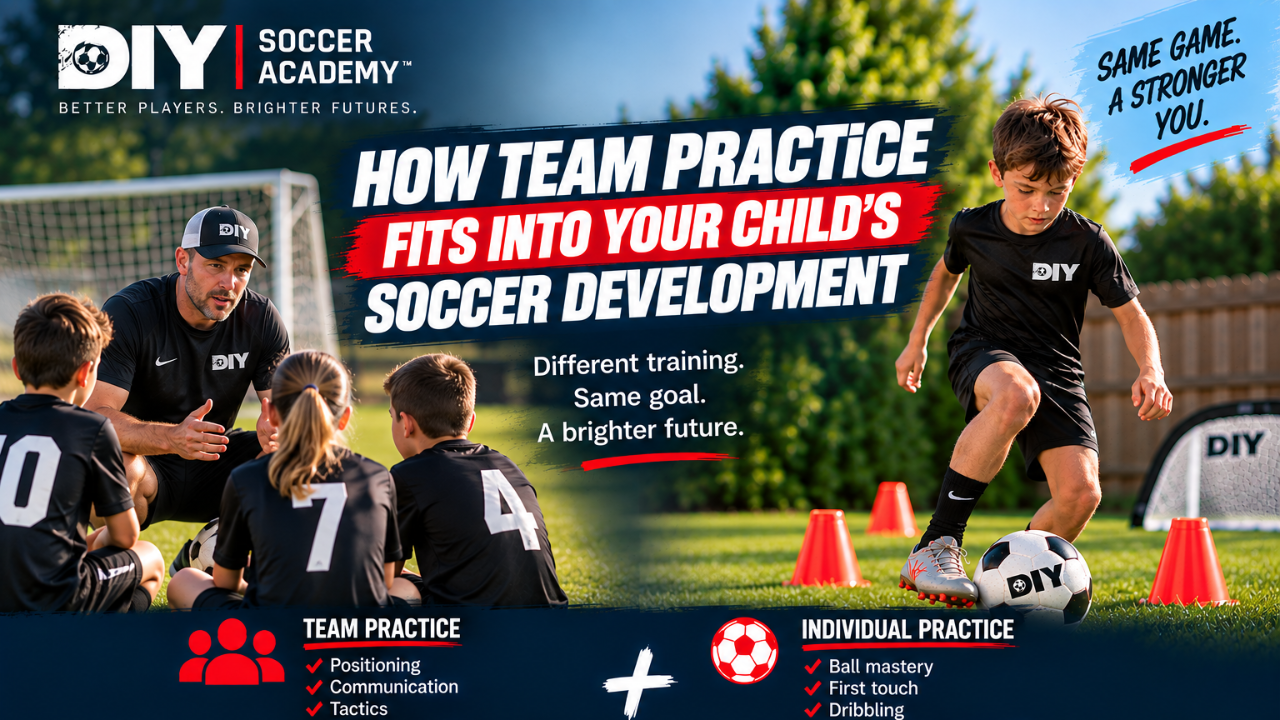
How Team Practice Fits Into Your Child’s Soccer Development
Published by DIY Soccer Academy™
Your child goes to soccer practice twice a week.
They work hard.
They listen to their coach.
They play games on the weekend.
So you might naturally wonder:
“Does my child really need to practice soccer outside of team practice?”
It's a great question.
And the answer starts with understanding what team practice is actually designed to do.
Team practice is incredibly important.
It's where young players learn how to play the game with other people.
They learn positioning.
They learn communication.
They learn tactics.
They learn how to defend together, attack together, and solve problems as a team.
But there's another part of player development that's harder to provide when one coach is responsible for an entire roster:
Individual technical repetition.
That's why team training and individual training shouldn't compete with each other.
They should work together.
What Is Team Practice Designed to Teach?
Soccer is a team sport.
Eventually, every skill your child develops has to work within a team environment.
A player might be excellent at dribbling alone in the backyard, but during a game they also need to know:
When should I dribble?
When should I pass?
Where should I move after I pass?
How can I create space for a teammate?
What should I do when we lose possession?
These are things team practice helps players learn.
A good team environment can develop areas such as:
-
Positioning
-
Communication
-
Passing combinations
-
Decision-making
-
Attacking principles
-
Defensive principles
-
Movement off the ball
-
Team shape
-
Small-sided game awareness
-
Understanding different positions
Those lessons are difficult to recreate when you're practicing alone.
That's why team practice is an essential part of development.
But Coaches Have an Entire Team to Develop
Imagine your child's coach has 12 players at practice.
Now imagine trying to give every one of those players hundreds of individual touches while also teaching positioning, tactics, passing combinations, defending, attacking, and teamwork.
There's only so much time.
Even a great coach has to divide attention across the entire team.
That's not a criticism of team coaches.
It's simply the reality of coaching a team.
The coach's job isn't just to develop your child's individual technique.
The coach also has to develop the team.
That means your child may not always receive the number of individual repetitions they need to become completely comfortable with the ball during team practice alone.
Team Practice and Individual Practice Have Different Jobs
This is one of the most important things soccer parents can understand.
Think of player development as two pieces working together.
Team Practice Helps Players Learn the Game
Team training gives players opportunities to develop:
⚽ Positioning
⚽ Communication
⚽ Decision-making
⚽ Team tactics
⚽ Passing combinations
⚽ Movement
⚽ Attacking and defending with teammates
Individual Practice Helps Players Build the Tools
Individual training gives players more opportunities to develop:
⚽ Ball mastery
⚽ First touch
⚽ Dribbling
⚽ Passing technique
⚽ Weak-foot ability
⚽ Coordination
⚽ Turns and soccer moves
⚽ Juggling
⚽ Comfort with the ball
One doesn't replace the other.
Individual training builds the tools. Team practice teaches players when and how to use them.
That's the relationship.
Think About Learning to Play an Instrument
Imagine your child is learning guitar.
They might eventually join a band.
Playing with the band teaches them how to:
Listen to other musicians.
Keep rhythm together.
Know when to play.
Know when not to play.
Work as part of something bigger.
But imagine they only touched their guitar during band rehearsal.
They'd probably have fewer opportunities to practice chords, finger positioning, scales, and difficult sections of songs.
Soccer works similarly.
Team practice teaches players how to perform together.
Individual practice gives them time to work on the skills they bring into that environment.
More Touches Create More Opportunities to Improve
Young players need experience with the ball.
A lot of it.
Every time a player controls the ball, turns, dribbles, passes, or uses their weaker foot, they're getting another opportunity to become more comfortable.
During team practice, those touches are shared across the entire group.
During individual training?
The ball can be at your child's feet almost the entire time.
That's one reason short individual sessions can be valuable.
You don't necessarily need another 90-minute practice.
You may simply need a short period where your child gets focused, purposeful repetitions.
Why 15 Minutes Can Complement Team Practice
When parents hear “extra training,” they sometimes imagine adding another major commitment to an already busy week.
Another drive.
Another practice.
Another hour or two.
It doesn't have to look like that.
A focused 15-minute individual training session can fit between team practices and give players opportunities to work specifically on their technique.
For example:
3 minutes — Ball mastery
4 minutes — Dribbling
3 minutes — First touch or passing
3 minutes — Weak foot
2 minutes — Juggling or a challenge
That's it.
The goal isn't to exhaust the player.
The goal is to create quality repetitions.
Individual Training Can Make Team Practice More Valuable
Here's where the two sides of development begin working together.
Imagine the coach is teaching a passing combination.
A player has to:
Receive the ball.
Control it.
Look up.
Choose a teammate.
Pass accurately.
Then move into another position.
If that player is still struggling just to control the first pass, much of their attention goes toward the ball.
But as their technical skills become more comfortable, they can devote more attention to what's happening around them.
Now they're able to think about:
Where is the defender?
Where is my teammate?
Where is the open space?
What should I do next?
Better technical comfort can give players more opportunity to focus on the game itself.
That's one reason individual development can complement team training so well.
Team Practice Gives Skills Context
There's also an important flip side.
A child could become very good at performing a scissors move around a cone.
But soccer isn't played against cones.
Eventually, they need to recognize:
When should I use the move?
Where is the defender positioned?
Which direction gives me space?
Should I dribble—or would passing be the better decision?
That's where team practice and games become so important.
Individual practice develops the movement.
Team environments give players opportunities to apply it under pressure and make decisions.
You need both.
What About Small-Sided Games?
Small-sided games can be especially valuable because they bring technical ability and decision-making together.
With fewer players on the field, children may have more opportunities to:
-
Touch the ball
-
Make decisions
-
Attack defenders
-
Receive under pressure
-
Find space
-
Pass
-
Defend
-
Transition between attacking and defending
They're no longer simply performing a technique.
They're learning how to use it in a soccer situation.
That's a critical part of development.
Your Child Doesn't Need to Train Every Day
Once parents understand the value of individual practice, there's another temptation:
More must be better.
Not necessarily.
Young players need balance.
They need team practice.
They need games.
They need individual development.
But they also need:
Rest.
School.
Friends.
Other interests.
And sometimes they simply need to kick a ball around because soccer is fun.
Development shouldn't become a race to fit as much training as possible into childhood.
The goal is to create a routine your family and player can realistically maintain.
Don't Turn Home Training Into Another Team Practice
Individual training doesn't need whistles, complicated drills, or constant correction from a parent.
In fact, parents don't need to become the coach at all.
A simple role for parents is to:
Create the opportunity.
Give your child a safe place to train.
Help them find a simple plan.
Encourage consistency.
Praise effort and improvement.
Then allow them to do the work.
Home training should help players become more comfortable and confident with the ball—not make soccer feel like another homework assignment.
A Simple Weekly Soccer Development Schedule
Every player's schedule will be different, but here's an example of how team and individual development might fit together:
Monday — 15-minute individual training
Work on ball mastery, dribbling, and weak foot.
Tuesday — Team practice
Apply skills with teammates and work on team concepts.
Wednesday — Rest or free play
Kick the ball around, juggle, or take the day off.
Thursday — Team practice
Decision-making, positioning, tactics, and game situations.
Friday — 15-minute individual training
Light technical work and confidence-building repetitions.
Saturday — Game
Compete, make decisions, and apply what you've learned.
Sunday — Rest
Recover and enjoy time away from structured training.
This isn't a schedule every player must follow.
It's simply an example of an important principle:
Development doesn't have to mean more and more training. It means giving different types of training the right purpose.
What Should My Child Practice Outside Team Training?
Start with the fundamentals.
Young players can benefit from spending individual training time on skills such as:
Ball Mastery
Become comfortable manipulating the ball with different surfaces of both feet.
Dribbling
Practice keeping the ball close, changing direction, and moving with both feet.
First Touch
Work on receiving the ball under control and preparing for the next action.
Passing
Develop clean technique with the inside of the foot and other appropriate surfaces.
Weak Foot
Give the less-comfortable foot purposeful repetitions.
Soccer Moves
Practice movements such as scissors, pullbacks, turns, and changes of direction.
Coordination
Develop balance, footwork, and control of the body.
Juggling
Challenge touch, coordination, concentration, and comfort with the ball.
You don't need to work on everything every day.
Pick a few areas. Get quality repetitions. Come back another day.
How Do I Know If the Balance Is Working?
Don't judge development only by goals scored or games won.
Look for smaller signs.
Is your child:
More comfortable receiving the ball?
Using both feet more often?
Asking for the ball?
Trying skills they've practiced?
Recovering more quickly after mistakes?
Making decisions faster?
Showing more confidence?
Enjoying training?
Those can all be meaningful signs of development.
Progress isn't always dramatic.
Often, it shows up through small changes that accumulate over time.
Where Confidence Fits In
Confidence connects everything.
When players have repeated a skill many times, they begin to trust themselves.
They've controlled that pass before.
They've performed that turn before.
They've used their weak foot before.
They've practiced that move before.
So when the opportunity appears during team practice or a game, the situation feels more familiar.
That's why we believe:
Preparation builds confidence.
Individual practice creates repetitions.
Team practice creates opportunities to apply them.
Games create opportunities to perform them under real pressure.
Together, they help build a more complete player.
The DIY Soccer Academy Philosophy
At DIY Soccer Academy™, we don't believe individual training should replace your child's team coach.
Quite the opposite.
Team soccer is essential.
Our goal is to help fill the space between team practices.
Foundation Academy™ gives young players structured, follow-along training focused on technical development through short, purposeful sessions they can complete at home.
Players can work on fundamentals such as:
-
Ball mastery
-
Dribbling
-
Passing
-
First touch
-
Coordination
-
Weak-foot development
-
Juggling
Then they can take those skills back to their team environment and continue learning how to use them in the game.
Team practice + individual development = a more complete development pathway.
Final Thoughts
So, where does team practice fit into soccer development?
Right in the center of it.
It's where young players learn to work with teammates.
Where they communicate.
Where they make decisions.
Where they learn positioning.
Where technical skills become soccer skills.
But team practice doesn't have to carry the entire burden of player development.
Short, purposeful individual training can give players additional opportunities to build the technical foundation they bring to their team.
Think of it this way:
Individual training builds the tools.
Team practice teaches you how to use them.
Games test them.
All three have a role.
And when they work together, young players can develop their skills, understanding, confidence, and love of the game.
Make the Time Between Team Practices Count
Your child's development doesn't have to stop when team practice ends.
With Foundation Academy™, young players can press play and follow Coach Scott through structured, purposeful training designed to complement their team environment.
⚽ One ball
🏡 A little space
⏱️ Just 15 minutes
📋 A clear training plan
Press Play. Follow Along. Get Your Touches.
Because team practice develops the team.
Purposeful individual training helps develop the player.
DIY Soccer Academy™
Every Great Player Starts With Confidence.™
Frequently Asked Questions
Is team practice enough for youth soccer development?
Team practice is an essential part of youth soccer development because players learn positioning, communication, decision-making, tactics, and how to play with teammates. However, because coaches are responsible for an entire team, players may have fewer opportunities for individual technical repetitions. Short individual sessions can complement team practice by providing additional touches on the ball.
What is the difference between team practice and individual soccer training?
Individual training builds the tools. Team practice teaches players how and when to use them.
Individual training can focus on technical skills such as ball mastery, dribbling, first touch, passing technique, weak-foot development, and juggling. Team practice provides the environment to apply those skills through positioning, communication, decision-making, tactics, and game situations.
Should my child practice soccer outside of team practice?
Additional practice can be helpful when it is age-appropriate, purposeful, and enjoyable. It doesn't need to mean adding another long training session. Even short periods of individual practice can give young players extra opportunities to work with the ball between team practices.
How often should my child practice soccer outside of team training?
There isn't one schedule that's right for every player. Age, team schedule, games, school, other activities, rest, and your child's enthusiasm for soccer should all be considered. For some players, a few short individual sessions each week may provide a good complement to regular team practices.
Can 15 minutes of individual soccer training make a difference?
Fifteen focused minutes can provide an opportunity for many purposeful touches without adding another lengthy practice to a child's schedule. The goal isn't to exhaust the player; it's to consistently create opportunities to work on technical skills.
What should my child practice at home?
Young players can focus on fundamental technical skills such as:
- Ball mastery
- Dribbling
- First touch
- Passing
- Weak-foot development
- Turns and soccer moves
- Coordination
- Juggling
Players don't need to practice everything during every session. Choose a few skills, focus on quality repetitions, and gradually build from there.
Why don't players get as many individual repetitions during team practice?
A team coach has an entire roster to develop. Practice time may need to include tactics, positioning, small-sided games, passing combinations, defending, attacking, and other team concepts. Individual training allows one player to spend more of their training time directly interacting with the ball.
Can individual training replace team practice?
No. Individual training and team practice develop different parts of a player's game. A player can practice dribbling, passing, and soccer moves individually, but soccer also requires teammates, opponents, communication, positioning, pressure, and decision-making.
Individual training should complement team soccer—not replace it.
Why are small-sided games important for young soccer players?
Small-sided games combine technical skills with real soccer decisions. Players have opportunities to receive the ball under pressure, find space, attack defenders, pass, defend, communicate, and transition between attacking and defending.
How does individual training help during team practice?
As technical skills become more comfortable, players may be able to devote more attention to what's happening around them. Instead of concentrating entirely on controlling the ball, they can begin looking for teammates, defenders, open space, and their next decision.
How can parents help with soccer development without becoming the coach?
Parents can create a safe place to practice, provide access to a ball and simple training plan, encourage consistency, and praise effort and improvement. Home training doesn't need to involve constant instruction or correction from a parent.
How do I know if my child's soccer training schedule is too much?
Pay attention to your child's enthusiasm, energy, recovery, and enjoyment. Young players need time for soccer, but they also need rest, school, friends, family, other interests, and unstructured play. Development shouldn't become a race to fit as much training as possible into childhood.
How do team practice, individual training, and games work together?
Each serves a different purpose:
Individual training → Builds the tools.
Team practice → Teaches players how to use them.
Games → Give players opportunities to apply them under real pressure.
Together, they can contribute to a more complete player-development experience.
How does DIY Soccer Academy complement team practice?
DIY Soccer Academy™ is designed to help fill the space between team practices, not replace a child's team coach. Foundation Academy™ provides short, structured, follow-along sessions focused on fundamentals such as ball mastery, dribbling, passing, first touch, coordination, weak-foot development, and juggling.
Players can press play, follow Coach Scott, get purposeful repetitions, and then take those developing skills back to their team environment.
Team practice develops the team. Purposeful individual training helps develop the player.