What Should I Practice When Training Soccer Alone?
Oct 01, 2026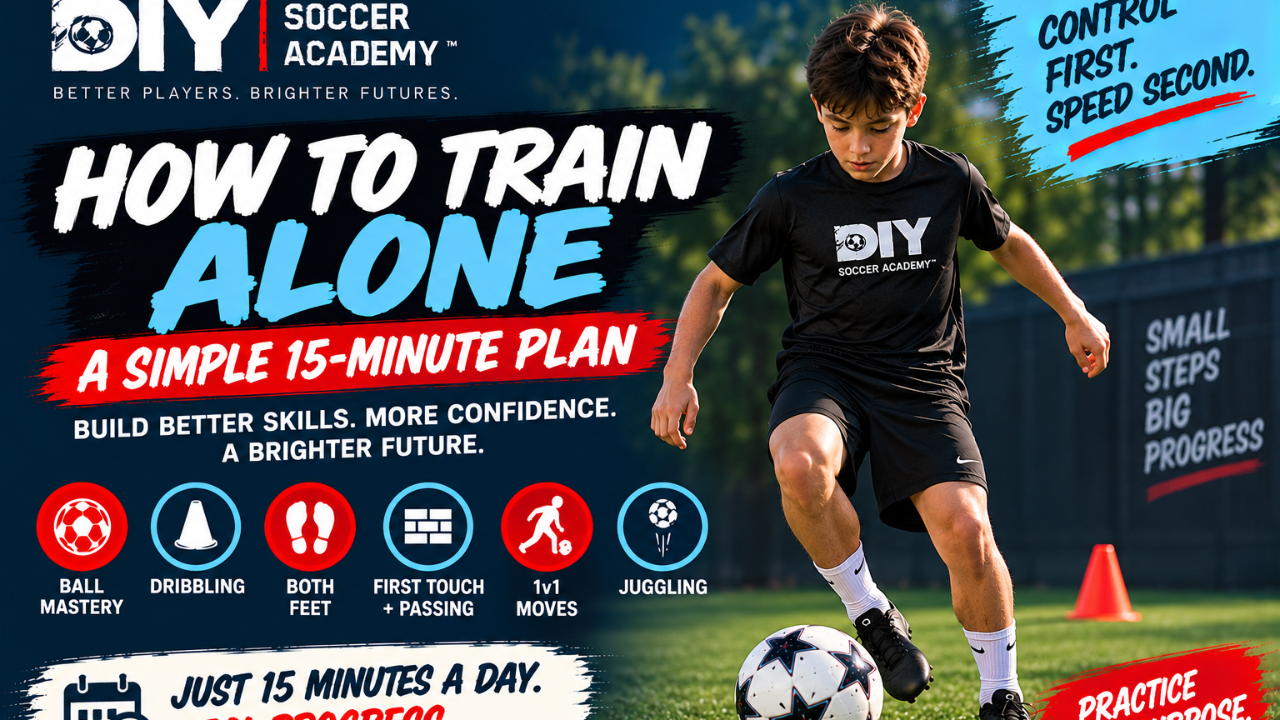
What Should I Practice When Training Soccer Alone?
Published by DIY Soccer Academy™
You grab your soccer ball.
You head into the backyard, driveway, basement, garage, or local field.
You're ready to train.
Then comes the question:
“What should I actually practice?”
Maybe you do a few toe taps.
Kick the ball against a wall.
Try some juggling.
Dribble around for a few minutes.
Then you're out of ideas.
Sound familiar?
One of the biggest challenges with individual soccer training isn't finding drills.
There are thousands of drills online.
The challenge is knowing which skills to work on and how to put them together into a purposeful training session.
The good news?
You don't need dozens of cones, expensive equipment, or a two-hour workout.
You need a ball, a little space, and a plan.
Let's build one.
What Should You Practice When Training Soccer Alone?
When you're training by yourself, focus on the technical skills you can improve through repetition.
That means spending time with the ball.
A good individual soccer session can include:
-
Ball mastery
-
Dribbling
-
First touch
-
Passing
-
Weak-foot development
-
1v1 moves
-
Turning
-
Coordination
-
Juggling
You don't have to practice every skill during every session.
Instead, choose a few areas and get quality repetitions.
Remember:
Control first. Speed second.™
1. Start With Ball Mastery
If you're wondering where to begin, start with the ball at your feet.
Ball mastery is about becoming comfortable manipulating the ball using different parts of both feet.
You can practice skills such as:
I's
Tik Toks
Toe Taps
Sole Rolls
Penguins
V's
Rolls Across the Body
The goal isn't simply to move your feet as quickly as possible.
Start slowly.
Keep the ball close.
Develop a rhythm.
Use both feet.
Then gradually increase your speed while maintaining control.
Why Ball Mastery Matters
Think about how often your feet interact with the ball during soccer.
Receiving.
Turning.
Dribbling.
Escaping pressure.
Changing direction.
Setting up a pass.
The more comfortable you become manipulating the ball, the less foreign those movements can feel.
Quality touches create familiarity.
2. Practice Dribbling With Both Feet
Next, get the ball moving.
You don't need a huge field.
Set up a few cones—or use shoes, water bottles, or other safe markers—and practice dribbling through them.
Focus on using:
Inside of the right foot
Outside of the right foot
Inside of the left foot
Outside of the left foot
Try changing direction.
Change your speed.
Keep the ball close when you're moving through tight spaces.
Push it farther ahead when you accelerate.
One simple setup is Figure-8 dribbling.
Place two markers several feet apart and dribble around them in the shape of an eight.
It may look simple.
But when you concentrate on using different surfaces of both feet, it becomes purposeful training.
3. Work on Your Weak Foot
This may be one of the most important things you can do when training alone.
Most players naturally want to use their stronger foot.
It feels easier.
More comfortable.
More accurate.
That's exactly why individual training is a great time to work on the other foot.
If your right foot is stronger, spend purposeful time with your left.
If your left is stronger, work on your right.
Practice:
⚽ Dribbling
⚽ Passing
⚽ Ball mastery
⚽ First touch
⚽ Turns
⚽ Juggling
At first, your weaker foot may feel awkward.
That's okay.
Don't avoid that feeling.
That's the skill you're trying to develop.
4. Practice Your First Touch
Your first touch happens constantly during soccer.
A teammate passes you the ball.
What happens next?
Does the ball stay close enough for your next action?
Or does it bounce several feet away?
Individual training can give you lots of opportunities to work on receiving the ball under control.
If you have a wall or rebounder, pass the ball against it and receive it back.
Try:
Right foot → receive → pass
Left foot → receive → pass
Receive across your body
Receive into space
Alternate feet
Don't simply kick the ball against the wall as quickly as possible.
Think about what your first touch is doing.
Your first touch should prepare your next action.
5. Practice Passing Against a Wall
A wall can be one of the simplest individual soccer training tools.
With permission and a safe surface, you can get repeated passing and receiving opportunities without needing another player.
Work on:
Inside-of-the-foot passing
Right-foot passing
Left-foot passing
Receiving before passing
One-touch passing when appropriate
Start close enough that you can maintain good technique.
As your accuracy improves, challenge yourself.
Can you hit the same target repeatedly?
Can you alternate feet?
Can you receive with one foot and pass with the other?
The goal isn't to smash the ball as hard as possible.
Accuracy and technique come first.
6. Practice 1v1 Soccer Moves
Training alone is a great time to learn the movement of a 1v1 skill before trying it against a defender.
Practice moves such as:
Scissors
Half Scissors
Pullbacks
Inside cuts
Outside cuts
V moves
Changes of direction
Start with the movement slowly.
Then add the ball.
Then increase the speed.
Finally, add the most important part:
Explode away from the imaginary defender.
A move isn't useful simply because it looks impressive.
The purpose is to create space.
So don't finish the move and stop.
Move → change direction → accelerate.
7. Practice Turning With the Ball
Soccer isn't always about going forward.
Sometimes pressure comes from one direction and you need to escape another.
That's why turning should be part of individual training.
Set up a marker.
Dribble toward it.
Imagine it's a defender.
Turn away.
Then accelerate.
Practice turning in both directions and using both feet.
The marker isn't actually defending you, of course.
But you're building the movement pattern so you can eventually practice recognizing and applying it in more realistic situations.
8. Spend Time Juggling
Juggling isn't the entire game of soccer.
But it can be a useful technical challenge.
It asks you to repeatedly control the ball while developing coordination and touch.
If you're new to juggling, don't worry about getting 100.
Start with:
Drop → kick → catch.
Then:
Drop → kick → kick → catch.
Gradually build from there.
And track your record.
Maybe today you get:
5.
Next month:
12.
Then:
25.
That gives you something measurable to chase.
Compete against yesterday's you.
Don't Forget Your Head
Here's something that can happen during individual training:
Players stare at the ball the entire time.
That's understandable when you're learning a new skill.
But soccer happens around you.
As you become more comfortable with a movement, challenge yourself to occasionally bring your eyes up.
Scan.
Look around.
Then return your attention to the ball when necessary.
The eventual goal isn't just to become comfortable with the ball.
It's to become comfortable enough that you can begin paying more attention to the game around the ball.
Should You Train Your Strengths or Weaknesses?
Both.
Your strengths are part of what makes you effective as a player.
Keep developing them.
But don't spend every individual session doing only the things you're already good at.
If your left foot feels uncomfortable?
Use it.
If your first touch needs work?
Practice it.
If you struggle changing direction?
Train it.
A useful individual training session should contain some success and some challenge.
If everything is easy, you may not be challenging yourself enough.
If everything feels impossible, simplify the skill and build from there.
You Don't Need 100 Different Soccer Drills
This is where many young players get stuck.
They search:
“Best soccer drills.”
Then another video appears.
And another.
And another.
Soon they know 50 drills—but don't consistently practice any of them.
You don't need endless drills.
You need purposeful repetition of important skills.
Five simple exercises performed consistently can be more useful than constantly jumping from one random drill to another without a plan.
Don't chase drills.
Build skills.
A Simple 15-Minute Individual Soccer Training Session
Don't know what to practice today?
Start here.
Minutes 0–3: Ball Mastery
Choose 2–3 movements.
For example:
I's → Tik Toks → Toe Taps
Focus on rhythm, control, and both feet.
Minutes 3–7: Dribbling
Use two or three markers.
Practice:
Inside/outside touches
Figure-8 dribbling
Changes of direction
Use both feet.
Minutes 7–10: First Touch + Passing
Use a wall or rebounder if available.
Pass.
Receive.
Control.
Repeat.
Alternate feet.
Minutes 10–13: Weak Foot
Choose one skill and deliberately use your less-comfortable foot.
Passing.
Dribbling.
Ball mastery.
Your choice.
Minutes 13–15: Juggling or Challenge
Finish with something measurable.
Try to beat your juggling record.
Count quality touches.
Time a dribbling challenge.
Or see how long you can perform a ball mastery skill without losing control.
Then you're done.
15 minutes. Purposeful training. Plenty of touches.
What If You Have More Than 15 Minutes?
Great.
But don't automatically turn a focused 15-minute session into an hour of random training.
You can add another focused block.
For example:
15 minutes — Technical training
Take a short break.
Then:
10 minutes — Passing and first touch
Or:
10 minutes — 1v1 moves and turns
The amount of time matters less than what you're doing with it.
Quality beats wandering around with a ball for an hour without a purpose.
Individual Training Can't Teach Everything
Individual practice is valuable.
But soccer isn't an individual sport.
You can't fully recreate:
Defenders
Teammates
Pressure
Positioning
Communication
Tactical decisions
Game speed
when you're training alone.
That's why individual training shouldn't replace team practice.
The two have different jobs.
Individual training builds the tools.
Team practice teaches you how to use them.
Games give you opportunities to apply them under pressure.
A complete player-development environment can include all three.
How Often Should You Train Soccer Alone?
There isn't one perfect number.
Your age, team schedule, games, school, recovery, other sports, and goals all matter.
But consistency is important.
You don't need one giant training session followed by six days of nothing.
Short, focused sessions can be easier to repeat.
For example:
15 minutes Monday.
15 minutes Wednesday.
15 minutes Friday.
That's 45 purposeful minutes with the ball outside team practice.
Keep doing that over time and those repetitions begin adding up.
Consistency beats occasional intensity.
Track Your Progress
Want individual training to become more motivating?
Track something.
Write down:
Juggling record
Sessions completed
Weak-foot passing streak
Dribbling time
Number of clean repetitions
New skills mastered
Then look back after four weeks.
Don't ask:
“Am I the best player on my team?”
Ask:
“What can I do now that I couldn't do four weeks ago?”
That's progress.
What If You Don't Feel Like Training?
This happens to everyone.
You won't feel motivated every day.
Instead of telling yourself you need to complete a huge workout, make the first step ridiculously simple.
Grab your ball.
Start the timer.
Do five minutes.
Sometimes you'll finish five minutes and stop.
Other times five minutes becomes 15.
The important part is building the habit of showing up.
You don't need a perfect training streak.
You need to keep coming back.
Make Individual Training Fun
You're playing soccer because you enjoy soccer.
Don't forget that.
Challenge yourself.
Create records.
Invent moves.
Try to beat yesterday's score.
Juggle.
Dribble around the backyard.
Pretend you're taking on a defender.
Sometimes structured practice is valuable.
Sometimes simply spending time experimenting with the ball is valuable too.
Young players shouldn't feel like every touch has to be homework.
Work hard—but keep loving the ball.
The DIY Soccer Academy Philosophy
At DIY Soccer Academy™, we believe one of the biggest obstacles to individual development isn't effort.
It's knowing:
“What should I practice today?”
That's why Foundation Academy™ is built around structured, follow-along training.
Instead of searching for random drills every time you want to practice:
Press play.
Follow Coach Scott.
Get your touches.
Keep improving.
Training focuses on fundamental areas including:
⚽ Ball Mastery
🔥 Dribbling
🎯 Passing
👟 First Touch
💪 Coordination
🦶 Weak-Foot Development
🏆 Juggling
All through short, purposeful sessions designed to complement team soccer.
Final Thoughts
So, what should you practice when training soccer alone?
Don't overcomplicate it.
Start with the fundamentals:
Control the ball.
Dribble with both feet.
Improve your first touch.
Practice passing.
Develop your weak foot.
Learn turns and 1v1 moves.
Challenge your juggling.
Then come back and do it again.
You don't need the perfect drill.
You don't need expensive equipment.
You don't need hours every day.
You need:
One ball.
A little space.
A clear plan.
And the consistency to keep showing up.
Because becoming a better soccer player isn't about finding one magical training session.
It's about stacking quality repetitions over time.
Control first. Speed second.™
Stop Wondering What to Practice
If you want to train on your own but aren't sure what to do, Foundation Academy™ gives you the plan.
Follow Coach Scott through structured, follow-along sessions designed to help young players develop their fundamentals and confidence.
One ball.
A little space.
Just 15 minutes.
PRESS PLAY → FOLLOW ALONG → GET YOUR TOUCHES → KEEP IMPROVING
DIY Soccer Academy™
Every Great Player Starts With Confidence.™
Frequently Asked Questions
What should I practice when training soccer alone?
Focus on technical skills that improve through repetition. A good individual soccer session can include ball mastery, dribbling, first touch, passing, weak-foot development, 1v1 moves, turns, coordination, and juggling. You don't need to practice everything every session. Choose a few areas and focus on quality repetitions.
How can I train soccer by myself at home?
You can train soccer alone with just a ball and a small amount of safe space. Start with ball mastery and dribbling, then add passing and first-touch work if you have access to a wall or rebounder. Finish with weak-foot practice, juggling, or a measurable challenge.
What are the best soccer drills to do alone?
Some simple individual soccer drills include toe taps, Tik Toks, sole rolls, V's, Figure-8 dribbling, inside-outside dribbling, wall passing, first-touch exercises, scissors, turns, and juggling. The best drills are ones that target a skill you want to improve and that you can perform consistently.
Is 15 minutes of soccer training enough?
A focused 15-minute session can provide many purposeful touches on the ball. Instead of focusing only on how long you train, focus on the quality of your repetitions and whether you can train consistently over time.
How often should I practice soccer by myself?
There isn't one perfect schedule for every player. Your age, team practices, games, school, recovery, and other activities all matter. A few short individual sessions throughout the week can be easier to maintain than occasionally doing one very long workout.
How can I improve my ball control when training alone?
Start with simple ball mastery exercises and perform them slowly enough to maintain control. Practice manipulating the ball with the inside, outside, and sole of both feet. As the movements become more comfortable, gradually increase your speed.
Control first. Speed second.™
How can I improve my weak foot by myself?
Deliberately include your weaker foot throughout your training. Practice dribbling, passing, first touch, ball mastery, turns, and juggling with it. Your weaker foot may feel uncomfortable initially, but purposeful repetitions can help make those movements more familiar.
How can I practice first touch alone?
A wall or rebounder can be useful for practicing first touch. Pass the ball against it, receive the return under control, and prepare the ball for your next action. Practice receiving with both feet, across your body, and into different directions.
Can I practice passing without another person?
Yes. If you have access to a safe wall or rebounder, you can practice passing by yourself. Work on accuracy and technique with both feet. You can also practice receiving with one foot and passing with the other.
How can I practice dribbling soccer alone?
Set up cones or safe markers and practice dribbling around them using different surfaces of both feet. Try Figure-8 dribbling, inside-outside touches, changes of direction, turns, and changes of speed. As your control improves, challenge yourself to look up more frequently.
Should I practice soccer with both feet?
Yes. Individual training is a great opportunity to deliberately work with both feet. Developing your less-comfortable foot can give you more options when receiving, passing, dribbling, and changing direction.
What soccer moves should I practice by myself?
Start with moves you can learn under control, such as scissors, half scissors, inside cuts, outside cuts, pullbacks, V moves, and turns. Learn the movement slowly before increasing the speed, and practice accelerating away after completing the move.
How do I practice soccer in a small space?
Small spaces can work especially well for technical training. Focus on ball mastery, tight dribbling, sole rolls, toe taps, V's, turns, weak-foot touches, and juggling. You don't need a full soccer field to get meaningful touches on the ball.
Is individual soccer training better than team practice?
They serve different purposes rather than replacing one another.
Individual training builds the tools.
Team practice teaches you how to use them.
Games let you apply them under pressure.
Individual training is especially useful for getting technical repetitions, while team environments provide teammates, defenders, communication, positioning, and decision-making.
How do I know if my individual soccer training is working?
Track your progress over time. You could measure your juggling record, completed sessions, dribbling time, weak-foot passing streak, or number of clean repetitions. Also look for changes during team soccer, such as feeling more comfortable on the ball or more willing to use both feet.
What equipment do I need to train soccer alone?
You can start with one soccer ball and a safe place to train. Cones are optional because other safe markers can work. A wall or rebounder can be helpful for passing and first-touch training but isn't necessary for every session.
How do I stay motivated when training soccer alone?
Give yourself a specific goal instead of simply going outside to “practice soccer.” Set a timer, choose a few skills, track your results, and challenge yourself to improve. On days when motivation is low, start with five minutes rather than skipping training because you can't complete a long session.
What is a good 15-minute soccer training routine?
A simple individual session could look like:
3 minutes: Ball mastery
4 minutes: Dribbling
3 minutes: First touch and passing
3 minutes: Weak-foot development
2 minutes: Juggling or a skill challenge
The goal isn't to squeeze as many drills as possible into 15 minutes. It's to get purposeful, controlled repetitions.
How can DIY Soccer Academy help me train soccer alone?
Foundation Academy™ removes one of the biggest challenges of individual training: figuring out what to practice.
Players can press play and follow Coach Scott through structured training focused on fundamentals such as ball mastery, dribbling, passing, first touch, coordination, weak-foot development, and juggling.
One ball. A little space. Just 15 minutes.
Press Play → Follow Along → Get Your Touches → Keep Improving.