Why Consistency Beats Talent in Soccer
Sep 17, 2026
Why Consistency Beats Talent in Soccer
Published by DIY Soccer Academy™
Have you ever played against someone and thought:
“They’re just naturally better than me.”
Maybe they're faster.
Maybe their dribbling looks effortless.
Maybe they can juggle 100 times while you're still trying to reach 20.
It can be easy to think great soccer players are simply born with more talent.
But here's something every young soccer player should understand:
Talent can give you a head start. Consistency determines how far you go.
The player who keeps showing up, keeps practicing, and keeps trying—even when improvement feels slow—can become a completely different player over time.
And that's something you can control.
What Does Consistency Mean?
Consistency doesn't mean practicing soccer for three hours every day.
It means doing the right things regularly.
Maybe that's:
- Practicing for 15 minutes after school
- Getting 100 extra touches on the ball
- Spending a few minutes using your weaker foot
- Practicing the same move until it feels natural
- Juggling several times each week
- Showing up to team practice ready to learn
One training session probably won't completely change your game.
But one session followed by another…
And another…
And another…
That's where improvement happens.
Small improvements add up.
Talent Is Only the Starting Point
Some players learn soccer skills faster than others.
That's okay.
Every player develops differently.
But imagine two players.
Player A
Player A has lots of natural ability.
Skills come easily.
Because of that, they don't practice very often.
Player B
Player B isn't the most talented player on the team.
But they practice consistently.
They work on their first touch.
They train both feet.
They practice dribbling.
They repeat their soccer moves.
They make mistakes and keep going.
Who do you think will be the better player a year from now?
Don't underestimate Player B.
Natural ability matters.
But ability without consistent work can only take a player so far.
Every Touch Counts
Here's one of the coolest things about soccer:
Every quality touch on the ball is an opportunity to improve.
Think about what happens if you get just a few hundred extra touches every week.
Those touches become thousands over several months.
You're practicing:
⚽ Controlling the ball
⚽ Moving with the ball
⚽ Using both feet
⚽ Changing direction
⚽ Improving coordination
At first, you might not notice a huge difference.
Then one day something happens.
A move that used to feel difficult suddenly feels easier.
Your first touch stays closer.
You use your weak foot without thinking about it.
You beat a defender with a move you've practiced dozens of times.
That's consistency showing up in your game.
You Don't Have to Be Great at Something Yet
Sometimes young players stop practicing a skill because they're not good at it.
Maybe you struggle with your left foot.
Maybe juggling is frustrating.
Maybe your scissors don't look smooth.
Maybe you keep losing control when you dribble quickly.
Here's what you need to remember:
You're practicing because you CAN'T do it well yet.
If you could already do everything perfectly, you wouldn't need practice.
Mistakes aren't proof that you're bad at soccer.
They're part of learning soccer.
When something is difficult, don't avoid it.
Slow it down. Try again.
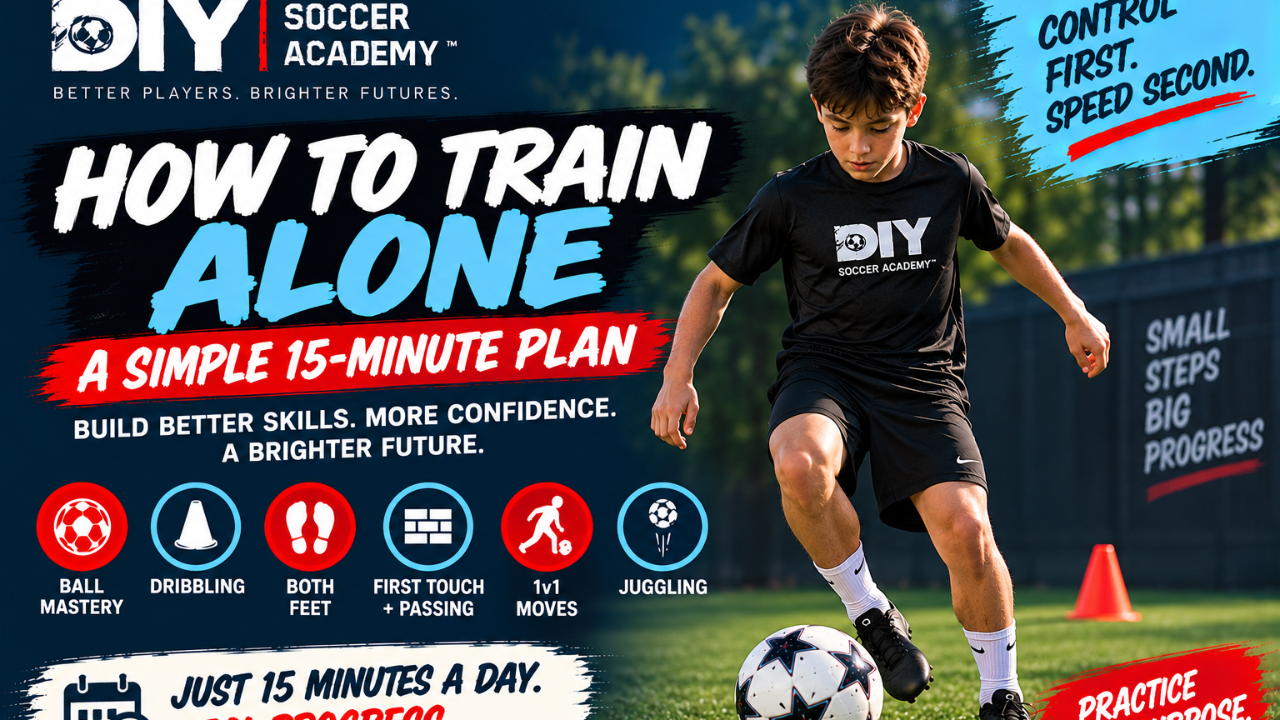
Control First. Speed Second.™
One of the biggest mistakes young players make when practicing is trying to go too fast.
They see professional players moving incredibly quickly and try to copy them.
But those players didn't start at that speed.
They built control first.
When learning a skill:
Step 1: Learn the movement.
Step 2: Perform it under control.
Step 3: Repeat it.
Step 4: Gradually increase your speed.
That's why we say at DIY Soccer Academy:
Control first. Speed second.™
Speed without control usually creates mistakes.
Control repeated consistently eventually creates speed.
Your Weak Foot Is a Great Example
Want to see how consistency works?
Use your weaker foot.
If you're right-footed, try dribbling only with your left foot for a few minutes.
It might feel awkward.
That's normal.
Do it again a few days later.
Still awkward?
Keep going.
Practice it every week.
Eventually, something starts changing.
The ball doesn't feel quite as uncomfortable.
Your touches become cleaner.
You start trusting that foot.
Eventually, you might even use it during a game without thinking about it.
Your weak foot didn't magically become better.
You trained it.
Don't Compare Your Chapter 2 to Someone Else's Chapter 10
You might have a teammate who seems much better than you right now.
Maybe they've been playing longer.
Maybe they practice more.
Maybe they're developing physically faster.
You don't know their entire story.
So don't make their progress your scoreboard.
Instead of asking:
“Am I better than them?”
Ask:
“Am I better than I was last month?”
Maybe your juggling record went from 8 to 15.
That's progress.
Maybe you can now perform scissors with both feet.
That's progress.
Maybe you're more comfortable receiving the ball.
That's progress.
Maybe you finally used your weak foot during a game.
That's progress.
Compete with the player you were yesterday.
The Days You Don't Feel Like Practicing Matter
Here's where consistency gets difficult.
Some days you'll be excited to train.
Other days?
Not so much.
You might be tired.
You might rather play a video game.
You might have had a difficult practice yesterday.
That's normal.
You don't have to complete a huge workout.
Sometimes the goal is simply:
Get the ball out and start.
Give yourself five minutes.
Once you start moving, you may want to keep going.
And if you only train for five focused minutes?
That's still five minutes you wouldn't have gotten otherwise.
Consistency doesn't require perfection.
It requires returning.
15 Minutes Can Add Up
Imagine training for just 15 minutes, four days per week.
That doesn't sound like much.
But that's:
60 minutes every week.
Over 10 weeks?
10 extra hours with the ball.
Over 40 weeks?
40 extra hours of purposeful soccer practice.
Now imagine how many touches you could get during those hours.
That's why short training sessions matter.
You don't always need to train longer.
You need to keep training.
Build a Simple Soccer Routine
Want to become more consistent?
Don't make training complicated.
Try something like this:
3 Minutes — Ball Mastery
Toe taps, foundations, I's, Tik Toks.
4 Minutes — Dribbling
Use both feet and keep the ball close.
3 Minutes — Soccer Move
Practice scissors, pullbacks, or another move.
3 Minutes — Weak Foot
Give your weaker foot extra touches.
2 Minutes — Challenge
Juggle, race the clock, or try to beat yesterday's score.
That's 15 minutes.
Then come back and do it again another day.
Track Your Small Wins
Improvement can be difficult to notice when you see yourself every day.
So keep track of something.
Your juggling record.
How many training sessions you completed.
How quickly you can finish a dribbling challenge while staying under control.
How many weak-foot passes you can complete accurately.
Then look back after a month.
You may be surprised by how much you've improved.
Those numbers aren't just scores.
They're proof that your work is adding up.
What Happens When You Stay Consistent?
Something interesting happens when you practice regularly.
Skills start becoming more natural.
You think less about controlling the ball.
You become more comfortable using both feet.
Moves become quicker.
Your first touch improves.
And that preparation can create something even more important:
Confidence.
You start thinking:
“I've done this before.”
Instead of hoping you can make the play, you begin trusting yourself to make it.
That's why confidence isn't just something you either have or don't have.
Confidence is built through preparation.
You Can Control Your Effort
You can't control everything in soccer.
You can't control how talented another player is.
You can't control who grows faster.
You can't control every referee decision.
You can't always control how much playing time you receive.
But you can control something incredibly important:
What you do next.
You can practice.
You can listen.
You can work on your weaknesses.
You can respond to mistakes.
You can show up again tomorrow.
Those choices might seem small.
Over time, they aren't.
The DIY Soccer Academy Challenge
Here's your challenge:
For the next four weeks, don't try to become an amazing soccer player overnight.
Instead, become a consistent soccer player.
Pick a realistic training goal.
Maybe it's:
15 minutes, three or four times each week.
Mark every session you complete.
Don't worry about being perfect.
Don't worry if another player is currently better.
Just keep stacking quality sessions.
At the end of four weeks, ask yourself:
What can I do now that I couldn't do four weeks ago?
That's the question that matters.
Final Thoughts
Talent is great.
But talent isn't your destiny.
The player who looks better today won't automatically be the better player tomorrow.
Soccer development happens through thousands of small moments:
One touch.
One repetition.
One mistake.
One correction.
One training session.
Then another.
You don't have to become great today.
You just have to keep getting better.
Because eventually, all those small improvements start showing up when it matters.
During practice.
During games.
And in your confidence with the ball.
So grab your soccer ball.
Find a little space.
And get to work.
Consistency beats talent when talent stops working.
Keep Showing Up. Keep Getting Better. ⚽
At DIY Soccer Academy™, we help young players build strong fundamentals and confidence through short, structured, follow-along training they can complete at home.
With Foundation Academy™, you don't have to wonder what to practice.
Press play.
Follow Coach Scott.
Get your touches.
And keep building.
Just 15 minutes a day.
Because becoming a better player isn't about having one amazing training session.
It's about showing up again tomorrow.
Every Great Player Starts With Confidence.™
Frequently Asked Questions
Why is consistency important in youth soccer?
Consistency gives young soccer players repeated opportunities to develop their skills. Regular practice helps players improve ball control, first touch, dribbling, passing, weak-foot ability, and coordination. Small improvements may not seem significant at first, but they can add up over weeks and months.
Is talent or hard work more important in soccer?
Natural ability can help a player learn certain skills more quickly, but consistent practice plays an important role in long-term development. Players who regularly work on their technique, weaknesses, and fundamentals give themselves more opportunities to improve.
How often should a young soccer player practice?
The right amount depends on the player's age, schedule, goals, and enjoyment of the game. Young players don't necessarily need hours of extra training. Short, focused sessions several times per week can provide additional touches without making soccer feel overwhelming.
Can 15 minutes of soccer practice really make a difference?
Yes. Fifteen minutes may seem short, but consistency makes those sessions add up. Training for 15 minutes four times per week equals an additional hour of practice each week—and about 40 hours over 40 weeks.
What should young soccer players practice on their own?
Individual training can focus on fundamental technical skills such as ball mastery, dribbling, first touch, passing, turning, juggling, coordination, soccer moves, and weak-foot development. Players should focus on quality repetitions and gradually increase difficulty as their control improves.
How can my child become more consistent with soccer training?
Make training simple and achievable. Instead of expecting an hour-long workout, create a routine your child can realistically maintain. For example, choose three or four days each week for a short training session and track completed sessions. The goal is to make practice a regular habit.
What if my child isn't naturally talented at soccer?
A young player's current ability doesn't determine how much they can improve. Players develop at different rates, and consistent practice gives children opportunities to improve their technique, coordination, decision-making, and confidence over time. Encourage your child to focus on their own progress instead of comparing themselves with teammates.
How can soccer players tell if they're improving?
Track small, measurable wins. Players can record things such as their juggling record, completed training sessions, weak-foot touches, dribbling times, passing accuracy, or mastery of new skills. They can also look for improvements that aren't numbers, such as feeling more comfortable receiving the ball or trying a skill during a game.
Does consistent practice help build confidence in soccer?
Consistent practice can help players feel more prepared. Repeating a skill successfully gives a player experience they can draw on during practices and games. Instead of wondering, “Can I do this?” they can begin thinking, “I've done this before.”
What should a young player do when they don't feel like practicing?
Start small. Grab a ball and commit to five focused minutes. Some days that may turn into a longer session; other days it may not. The important lesson is that consistency doesn't require perfection—it requires returning.
Should young soccer players practice their weaknesses or strengths?
Both. Players should continue developing their strengths while also dedicating time to areas that need improvement. If a player's weaker foot, first touch, or a particular move feels uncomfortable, regular controlled repetitions can gradually make that skill feel more natural.
How can DIY Soccer Academy help players train consistently?
Foundation Academy™ gives young players structured, follow-along training so they don't have to figure out what to practice on their own. Players can press play, follow Coach Scott, get purposeful touches, and work on their fundamentals in short training sessions designed to fit into family schedules.
Control first. Speed second.™
Every Great Player Starts With Confidence.™