How Can I Get Better at Juggling a Soccer Ball?
Oct 08, 2026
How Can I Get Better at Juggling a Soccer Ball?
Published by DIY Soccer Academy™
You drop the ball.
Kick it once.
Maybe twice.
Then it shoots off to the side.
You chase it down, pick it up, and try again.
Sound familiar?
If you're learning how to juggle a soccer ball, it can be frustrating—especially when you see another player casually knock out 50 or 100 juggles without the ball touching the ground.
But here's the important thing to understand:
Nobody starts at 100.
Juggling is a skill.
And like every soccer skill, it improves through technique, repetition, patience, and consistency.
Whether your current record is 1, 5, 20, or 100+, there's always another level to chase.
Here's how to get better.
Why Should Soccer Players Practice Juggling?
Juggling isn't the game of soccer.
Being able to juggle 500 times doesn't automatically make someone a great soccer player.
But juggling can be a valuable technical exercise because it challenges you to repeatedly control the ball.
As you practice, you're working on things like:
-
Touch
-
Coordination
-
Balance
-
Body control
-
Using both feet
-
Judging the movement of the ball
-
Concentration
-
Comfort with the ball
Most importantly, juggling gives young players something that's easy to measure.
Yesterday your record was 8.
Today you got 11.
Next week you reach 20.
That's progress you can see.
Don't compare your juggling record to another player. Compare it to yesterday's you.
How Do You Juggle a Soccer Ball?
Before worrying about your record, learn the basic technique.
Start by holding the ball in your hands.
Drop it toward your foot.
Use the top of your foot to gently play the ball back into the air.
Then catch it.
That's it.
Drop → Kick → Catch
Your goal isn't to kick the ball as high as possible.
You're learning to control where the ball goes.
Ideally, the ball should come back up in front of you where you can comfortably catch it.
Once you can consistently do that, you're ready to progress.
Step 1: Master One Touch
If you're a beginner, forget about getting 10 juggles.
Start with one great touch.
Hold the ball.
Drop it.
Kick it.
Catch it.
Repeat.
Try:
Right foot → catch
Then:
Left foot → catch
Your goal is to make the ball come back toward your hands instead of flying forward, backward, or sideways.
Can you do that five times in a row?
Ten?
Great.
Now you're developing control.
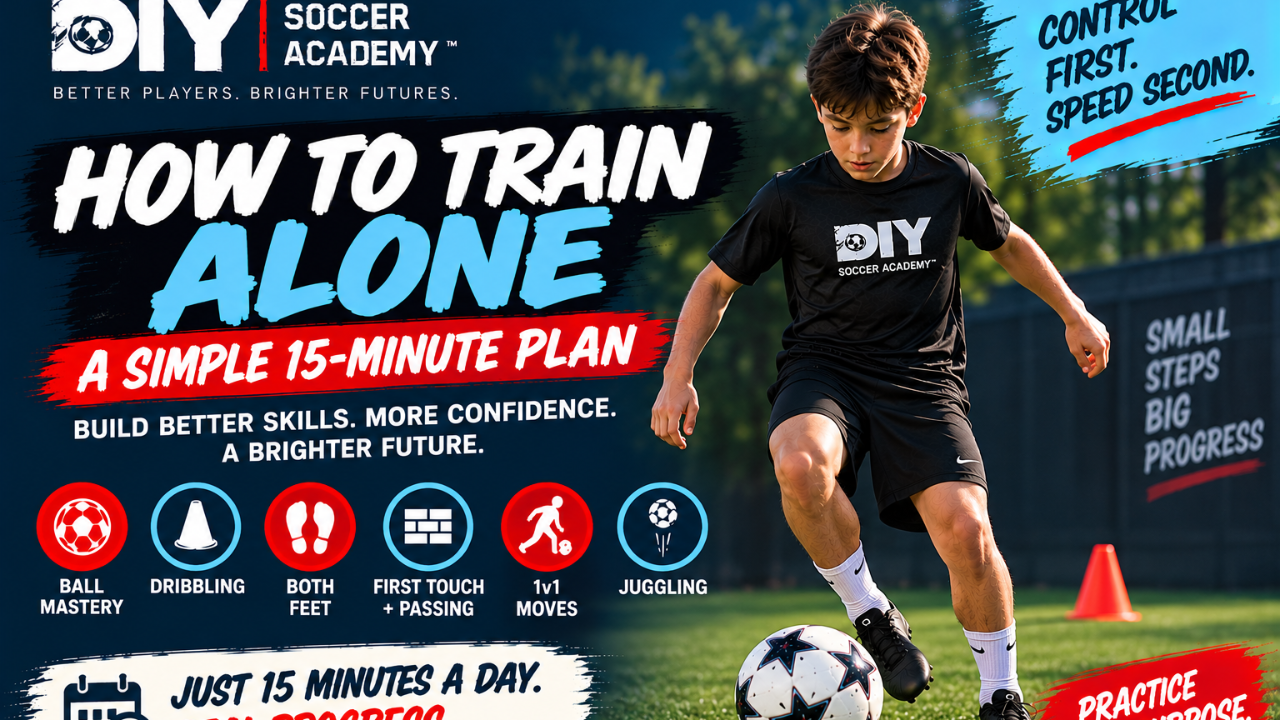
Control first. Speed second.™
Step 2: Go From One Touch to Two
Once one touch becomes comfortable, add another.
Drop → Kick → Kick → Catch
At first, you might use the same foot twice.
That's okay.
But eventually, start challenging yourself to use both feet.
Try:
Right → Left → Catch
Then:
Left → Right → Catch
This begins teaching your body to adjust to the ball instead of relying exclusively on your stronger foot.
Don't rush to five or ten touches.
First, become comfortable getting two clean touches consistently.
Step 3: Build a Juggling Ladder
One of the simplest ways to improve is by using a progression.
Think of it like climbing a ladder.
Level 1
1 juggle → catch
Level 2
2 juggles → catch
Level 3
3 juggles → catch
Level 4
4 juggles → catch
Level 5
5 juggles → catch
Keep climbing.
If you lose control at Level 4, don't get frustrated.
Start again.
The goal is to gradually make each level feel easier.
Eventually, you won't need to catch the ball.
You'll simply keep going.
Step 4: Use Both Feet
Many players develop a habit when they first start juggling.
They use their dominant foot for almost everything.
Right.
Right.
Right.
Right.
Or:
Left.
Left.
Left.
Left.
That may help you get a higher number initially, but it can also allow your weaker foot to keep falling behind.
Challenge yourself to alternate.
Right → Left → Right → Left
At first, your weaker foot may send the ball everywhere.
That's normal.
Instead of avoiding it, keep giving it repetitions.
You can even create separate challenges:
Right foot only
Left foot only
Alternating feet
Your overall juggling record might temporarily go down when you start involving your weaker foot.
That's okay.
You're not just chasing a number.
You're developing both feet.
Step 5: Keep Your Touches Controlled
One of the most common juggling mistakes is kicking the ball too high.
The ball goes over your head.
You take three steps backward.
Then five steps forward.
Then you're chasing it across the yard.
Try to keep your touches controlled.
For many basic foot-juggling exercises, keeping the ball around waist height or below can make it easier to prepare for the next touch.
Think:
Soft touch.
Controlled height.
Prepare for the next touch.
Your next touch becomes much easier when your previous touch puts the ball where you want it.
Step 6: Find the Right Part of Your Foot
When you're juggling with your feet, try to create a relatively stable surface with the top of your foot.
You don't want a floppy ankle sending the ball in a different direction every time.
Keep your ankle controlled and focus on contacting the ball consistently.
If the ball keeps flying forward, sideways, or behind you, don't simply try harder.
Pay attention to where your foot is contacting the ball and the angle of your foot at contact.
Small changes can make a big difference.
Step 7: Stay Light on Your Feet
Juggling isn't just your foot touching the ball.
Your entire body is constantly adjusting.
Stay balanced.
Keep your knees slightly bent.
Be ready to move.
Use small adjustments instead of waiting until the ball gets far away from you.
As your control improves, you should feel less like you're chasing the ball and more like you're keeping it within your space.
Don't Chase a Bad Touch
Here's a useful habit:
If the ball gets away from you, reset.
Young players sometimes become so focused on saving their juggling streak that they develop wild movements trying to keep the ball alive.
There's value in learning to adjust, but when you're specifically practicing clean technique, don't be afraid to stop.
Pick up the ball.
Reset.
Start again.
Quality repetitions matter.
Practice Your Weak Foot Separately
If your weaker foot is holding you back, give it its own training time.
Try:
Drop → weak foot → catch
Repeat 10 times.
Then:
Drop → weak foot → weak foot → catch
Or alternate:
Strong → weak → catch
This removes some of the pressure of trying to break your overall record and lets you focus specifically on improving your weaker side.
Over time, that weaker foot can become much more comfortable.
How Often Should I Practice Juggling?
You don't need a marathon juggling session.
Juggling is easy to add to the end of another soccer workout.
Try spending a few focused minutes practicing it regularly.
You could finish an individual session with:
2 minutes of juggling
or
10 attempts to beat your personal record.
Short challenges can make it easier to stay focused and keep juggling fun.
Consistency matters more than having one giant session and then ignoring juggling for weeks.
Try the 5-Minute Juggling Challenge
Want a simple routine?
Set a timer for five minutes.
Minute 1 — Right Foot
Drop → right foot → catch
Focus on clean contact.
Minute 2 — Left Foot
Drop → left foot → catch
Give your weaker foot purposeful repetitions.
Minute 3 — Alternating Feet
Right → left → catch
Then build toward:
Right → left → right → left
Minute 4 — Juggling Ladder
Start at one.
Then two.
Then three.
See how high you can climb.
Minute 5 — Beat Your Record
Now go for it.
Try to beat your personal best.
Five minutes. One ball. One number to chase.
Keep Track of Your Juggling Record
This is one of my favorite parts of juggling for young players.
It's measurable.
Write down your personal best.
For example:
Week 1: 4
Week 2: 7
Week 3: 12
Week 4: 18
Not every week will be a new record.
Some days you may struggle to get close to your best.
That's part of learning.
Look at the trend over time instead of judging yourself by one training session.
Track progress—not perfection.
What If My Juggling Record Isn't Improving?
This is where players can become frustrated.
You practice.
Your record stays at 10.
Then 10 again.
Then 9.
Then 10.
It feels like you're not improving.
But your highest number isn't the only sign of progress.
Ask yourself:
Are my touches more controlled?
Am I using both feet more often?
Am I chasing the ball less?
Can I consistently get close to my personal best?
Does my weaker foot feel more comfortable?
You might not have broken your record yet, but your overall control may still be improving.
Sometimes the breakthrough comes after the technique becomes more consistent.
Should Kids Practice Juggling Every Day?
They can practice frequently if they're enjoying it and it fits appropriately with their overall activity and recovery.
But juggling shouldn't become a punishment.
Turning every session into:
“You can't stop until you get 50!”
can quickly take the fun out of it.
Instead, create achievable challenges.
Try:
Can you beat yesterday's record?
Can you get five alternating touches?
Can you get three with your weaker foot?
Can you complete the juggling ladder?
Give young players goals they can chase.
Juggling Isn't the Goal—Becoming More Comfortable With the Ball Is
This is important.
Soccer isn't a juggling competition.
A player could be an excellent juggler and still need to develop dribbling, passing, first touch, decision-making, positioning, and other parts of the game.
So don't let juggling take over your entire training program.
Use it as one piece of your development.
At DIY Soccer Academy™, juggling sits alongside other fundamentals such as:
⚽ Ball mastery
🔥 Dribbling
🎯 Passing
👟 First touch
🦶 Weak-foot development
💪 Coordination
The goal is to develop a more complete and confident player.
The DIY Soccer Academy Juggling Challenge
Here's a simple challenge you can start today.
Grab your ball.
Find a safe place to train.
Record your current personal best.
Then spend the next four weeks practicing consistently.
At the end of four weeks, test yourself again.
Write down:
BEFORE: ______
AFTER: ______
Maybe you go from 3 to 8.
Maybe 10 to 25.
Maybe 40 to 60.
Your number doesn't need to match anyone else's.
There's only one player you're trying to beat:
Yesterday's you.
Final Thoughts: How Do You Get Better at Juggling?
If you want to improve your soccer juggling, don't make it complicated.
Start with:
Drop → Kick → Catch
Then build:
One touch → Two touches → Three touches → Keep going
Use both feet.
Keep your touches controlled.
Practice your weaker foot.
Stay balanced.
Track your record.
And keep coming back.
You don't need to become an incredible juggler overnight.
You need to get a little more comfortable with the ball over time.
Small touches. Consistent practice. Real progress.
Control first. Speed second.™
Ready to Keep Building Your Skills?
Juggling is just one part of becoming more comfortable and confident with the soccer ball.
Foundation Academy™ gives young players structured, follow-along sessions with Coach Scott covering fundamental skills like ball mastery, dribbling, passing, first touch, coordination, weak-foot development, and juggling.
Instead of wondering what to practice:
PRESS PLAY → FOLLOW COACH SCOTT → GET YOUR TOUCHES → KEEP IMPROVING
One ball. A little space. Just 15 minutes.
DIY Soccer Academy™
Every Great Player Starts With Confidence.™
Frequently Asked Questions
How can I get better at juggling a soccer ball?
The best way to improve is to start with controlled touches and gradually increase the difficulty. Beginners can use Drop → Kick → Catch, progress to two or three touches, and eventually juggle continuously. Focus on clean technique, using both feet, and practicing consistently rather than only chasing a high number.
How do beginners learn to juggle a soccer ball?
Start by holding the ball in your hands, dropping it toward one foot, kicking it back into the air, and catching it.
Practice:
Drop → Kick → Catch
Once you can consistently control one touch, progress to:
Drop → Kick → Kick → Catch
Continue adding touches as your control improves.
What part of your foot should you use when juggling?
For basic foot juggling, try to contact the ball with the top of your foot while keeping your ankle controlled. The goal is to send the ball upward in a predictable direction so you're prepared for your next touch.
How high should the ball go when juggling?
Beginners generally want controlled touches rather than kicking the ball high into the air. Keeping basic juggling touches around waist height or below can make it easier to stay balanced and prepare for the next touch.
Why does the ball keep going forward when I juggle?
The angle of your foot and where you contact the ball can send it forward. Focus on getting your foot underneath the ball enough to send it upward rather than kicking through it like a pass or shot. Slow down and work on one controlled touch at a time.
Why do I keep losing control when juggling?
Common causes include kicking the ball too hard, inconsistent contact, a loose ankle, relying too heavily on one foot, or waiting too long to adjust your body. Reduce the difficulty and focus on controlled repetitions before trying to break your record.
Should I juggle with both feet?
Yes. Learning to juggle with both feet can challenge your coordination and help you become more comfortable using your less-dominant foot. Try alternating:
Right → Left → Right → Left
You can also practice each foot separately.
How can I improve juggling with my weak foot?
Give your weaker foot dedicated repetitions. Start with Drop → Weak Foot → Catch and repeat it until the touch becomes more consistent. Then progress to two weak-foot touches or alternate between your stronger and weaker foot.
How many juggles should a beginner be able to do?
There isn't one number every beginner needs to reach. A player's age, experience, coordination, and practice history can all affect their juggling ability.
Instead of comparing yourself with other players, establish your current personal best and work on improving it.
Is 10 juggles good for a beginner?
Ten consecutive juggles can be a meaningful milestone for a player learning the skill, but the number itself isn't as important as improvement. A player progressing from 2 to 10 has made significant personal progress regardless of what another player can do.
How long does it take to get good at soccer juggling?
There isn't a universal timeline. Some players develop juggling quickly while others need more repetitions. Consistent short practice sessions can be more useful than worrying about how quickly another player reached a particular number.
How often should I practice juggling?
Juggling can be practiced regularly in short sessions. For example, you might spend a few focused minutes juggling at the end of an individual soccer workout or give yourself 10 attempts to beat your personal record.
Can I practice juggling every day?
Players can practice juggling frequently when it fits appropriately with their overall training, activities, and recovery. It doesn't need to be a long workout. Even a short juggling challenge can provide additional touches on the ball.
Does juggling make you a better soccer player?
Juggling alone doesn't make someone a complete soccer player, but it can be a useful technical exercise for developing touch, coordination, balance, concentration, comfort with the ball, and use of both feet.
Players still need to develop other areas such as dribbling, passing, first touch, movement, decision-making, and game awareness.
Does juggling improve your first touch?
Juggling can help players become more comfortable judging and controlling a moving ball, but it shouldn't replace realistic first-touch exercises. Receiving passes from a teammate, wall, or rebounder adds different challenges that are important for soccer.
What's the fastest way to improve soccer juggling?
Rather than searching for a shortcut, focus on good technique and consistent repetitions. A simple progression is:
1 touch → catch
2 touches → catch
3 touches → catch
Alternate feet
Continue without catching
Master each step before making the exercise harder.
What is a good soccer juggling challenge?
Try a 5-minute juggling challenge:
Minute 1: Right foot
Minute 2: Left foot
Minute 3: Alternate feet
Minute 4: Juggling ladder
Minute 5: Try to beat your personal record
Record your score and repeat the challenge regularly.
How do I get from 10 juggles to 50?
Instead of constantly attempting 50, work on making your first 10–20 touches more repeatable. Keep the ball close, use controlled touches, stay balanced, and gradually involve both feet. As your consistency improves, longer juggling streaks can follow.