How to Improve Your Weak Foot in Soccer
Aug 20, 2026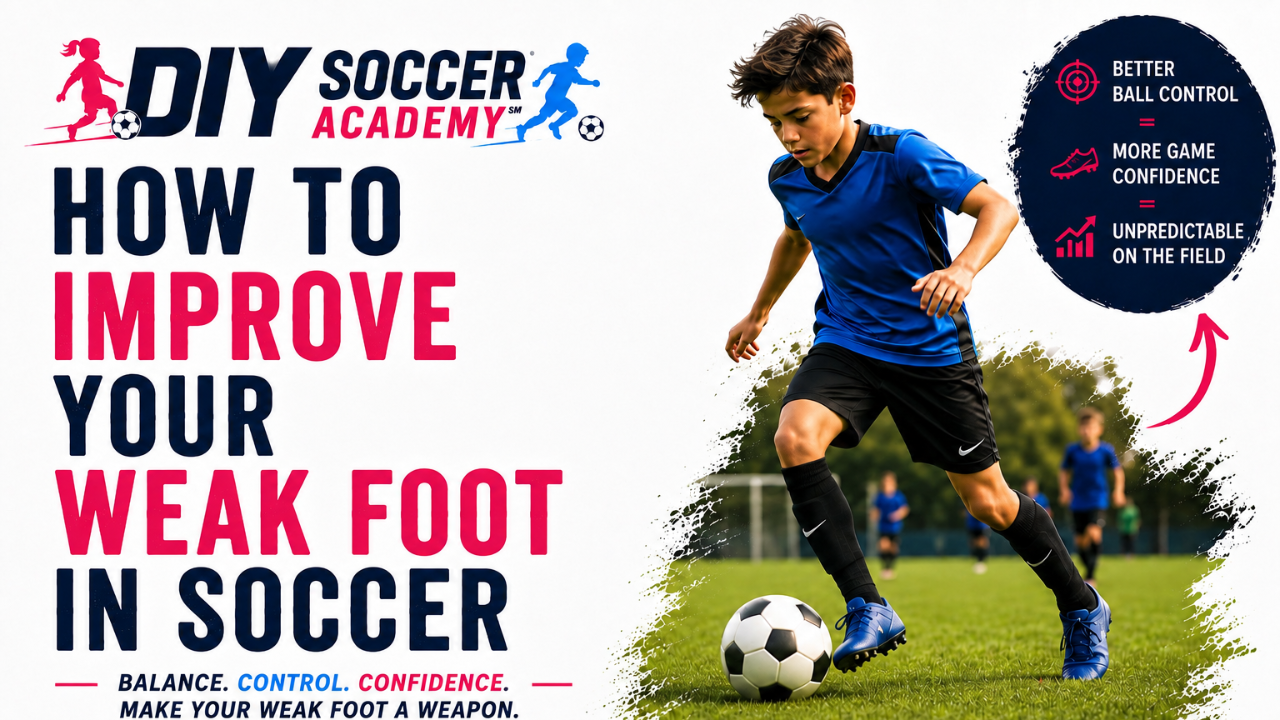
How to Improve Your Weak Foot in Soccer
Published by DIY Soccer Academy
Helping your child become a more confident, complete soccer player starts with developing both feet.
Most young soccer players naturally favor one foot. They dribble with it, pass with it, shoot with it and when the ball comes to their weaker side, they often take an extra touch to get it onto their preferred foot.
That’s completely normal.
But developing the weak foot can make a big difference in your child’s confidence, ball control, passing, dribbling and decision-making during games.
The good news? Your child doesn’t need hours of extra training to improve. A few focused minutes of practice each day can make a meaningful difference over time.
Why Is the Weak Foot Important?
Soccer is a fast game. Players often have only a few seconds, or less, to control the ball, make a decision, and execute a pass, dribble, or shot.
When a player can comfortably use both feet, they have more options.
A stronger weak foot can help your child:
- Control the ball more comfortably
- Make quicker decisions under pressure
- Pass in more directions
- Receive the ball on either side
- Dribble more effectively
- Shoot with either foot
- Protect the ball from defenders
- Play with greater confidence
Instead of thinking, “I need to get the ball onto my right foot,” they can simply think, “What should I do next?”
That is a major advantage.
Start With Simple Touches
One of the biggest mistakes parents and young players make is trying to improve the weak foot with complicated drills right away.
Keep it simple.
The goal at first isn't speed. It's comfort and control.
Start with basic touches using only the weaker foot:
1. Inside-Outside Touches
Have your child move the ball from side to side using the inside and outside of their weak foot.
Start slowly.
Focus on keeping the ball close and making clean touches.
As control improves, gradually increase the speed.
2. Foundation Touches
Have your child pass the ball between the inside of their feet, but emphasize using the weak foot as much as possible.
This develops coordination and helps the player become more comfortable making repeated touches with their weaker side.
3. Toe Taps
Place one foot on top of the ball and alternate feet.
Once your child is comfortable, challenge them to complete more of the movement using their weaker side or finish with a weak-foot touch.
Toe taps are simple, but they can help develop coordination, balance, rhythm, and comfort with the ball.
Make Your Child Use Their Weak Foot
One of the most effective ways to improve a weak foot is also one of the simplest:
Use it.
During practice, create situations where your child has to make decisions with their weaker foot.
For example:
- Pass using only the weak foot.
- Dribble around cones using the weak foot.
- Receive passes with the weak foot.
- Shoot using the weak foot.
- Complete a set number of touches with the weak foot before switching.
At first, this may feel awkward.
That's okay.
Your child isn't supposed to be as comfortable with their weak foot as their dominant foot right away.
The goal is to gradually close the gap.
Practice Passing With the Weak Foot
Passing is one of the easiest ways to incorporate weak-foot training into a regular soccer routine.
Find a wall, partner, or passing target.
Have your child:
- Pass the ball with their weak foot.
- Receive the return pass.
- Take their first touch with the weak foot.
- Pass again.
Start from a short distance.
Once they can consistently make clean passes, move farther away or increase the pace.
Focus on technique before power.
Encourage your child to focus on:
- Planting the standing foot beside the ball
- Keeping the ankle firm
- Striking the middle of the ball
- Following through toward the target
- Keeping the ball under control
A controlled 10-yard pass is more valuable than a powerful pass that goes nowhere near the target.
Don't Forget the First Touch
Weak-foot development isn't just about passing and shooting.
First touch is one of the most important areas to develop.
A player may receive the ball on their weak side during a game and have only a moment to control it.
If they can confidently take that first touch with either foot, they can turn away from pressure, move into space, or make their next pass much faster.
Try this simple exercise:
Pass → Receive → Move
Have your child pass the ball against a wall. When it comes back, they should use their weak foot to control the ball into space.
Then repeat.
As they improve, challenge them to take their first touch in different directions.
Practice Weak-Foot Dribbling
Dribbling is another great opportunity to develop the weaker foot.
Set up a few cones or objects and create a simple dribbling course.
Start by asking your child to:
- Keep the ball close
- Use small touches
- Use the weak foot as much as possible
- Keep their head up when possible
- Change direction with the weak foot
Don't worry about making the course complicated.
A simple setup with five cones can provide plenty of valuable practice.
Control first. Speed second.
That's especially important when developing a weak foot.
If your child rushes through the drill, they may develop poor habits just to finish faster.
Slow, controlled repetitions build a stronger foundation.
Add Weak-Foot Shooting
Once your child becomes more comfortable controlling and passing with their weak foot, introduce shooting.
Start close to the goal.
Focus on technique rather than power.
Have your child take several controlled shots using their weak foot.
Then gradually increase the distance.
You can also create simple challenges:
“How many can you put on target out of 10?”
This gives your child something measurable to work toward without making the session feel overwhelming.
Make It Part of Every Training Session
Your child doesn't need an entire training session dedicated to their weak foot.
In fact, incorporating weak-foot work into regular training can be more effective.
For example, during a 15-minute training session, you might spend:
3 minutes: Ball mastery
4 minutes: Weak-foot dribbling
4 minutes: Weak-foot passing and first touch
4 minutes: Weak-foot shooting or finishing
The exact activities can change, but the important thing is consistency.
15 focused minutes, repeated regularly, can add up to a lot of quality practice over time.
Turn Weak-Foot Training Into a Challenge
Young players often respond well when practice feels like a game.
Instead of simply telling your child to “work on your weak foot,” create challenges.
Try:
The 10-Pass Challenge
How many accurate weak-foot passes can your child complete in a row?
The Juggling Challenge
How many consecutive touches can they get while incorporating their weak foot?
The Dribbling Challenge
Can they complete a cone course using primarily their weak foot?
The Shooting Challenge
How many of 10 weak-foot shots can they put on target?
Record their results.
Then try again the following week.
This is where progress becomes visible.
Don't Expect Overnight Results
Developing a weak foot takes time.
Your child may initially feel uncomfortable, lose control of the ball, or become frustrated.
That's part of the process.
Instead of focusing on whether their weak foot is already “good,” focus on whether they're better than they were last week.
Celebrate small improvements:
“You completed five more passes than last time.”
“Your first touch looked much better today.”
“You used your weak foot without thinking about it.”
Those small wins build confidence.
And confidence encourages players to keep practicing.
A Simple Weekly Weak-Foot Plan
If you're looking for an easy way to get started, try this:
| Day | Focus |
|---|---|
| Monday | Weak-foot ball mastery |
| Tuesday | Weak-foot passing |
| Wednesday | Weak-foot dribbling |
| Thursday | Weak-foot first touch |
| Friday | Weak-foot shooting |
| Saturday | Combine everything |
| Sunday | Rest or play |
You don't need to spend hours training.
The goal is short, consistent, purposeful practice.
The Biggest Secret: Consistency
The weak foot doesn't become stronger because a player practices it once.
It improves because they use it again and again and again.
That's why we encourage young players to make weak-foot development part of their regular training routine.
A few minutes today.
A few more tomorrow.
Then again next week.
Over time, those repetitions can turn an uncomfortable foot into a reliable tool.
And eventually, your child may stop thinking about which foot they're using altogether.
That's the goal.
Help Your Child Build Confidence With Both Feet
At DIY Soccer Academy, we believe player development doesn't have to be complicated.
Young players need structured training, consistent practice, and the right skills taught at the right time.
Whether your child is just beginning their soccer journey or looking to become more confident with the ball, developing both feet is an important part of becoming a more complete player.
Start small.
Practice consistently.
Celebrate progress.
And remember:
Don't compare your child to another player. Compare them to where they started.
Ready to Make Soccer Practice Part of Your Child's Routine?
Foundation Academy gives young players structured, follow-along soccer training they can complete at home in just 15 minutes a day.
With training focused on ball mastery, dribbling, passing, first touch, coordination, and weak-foot development, your child can build their skills one session at a time.
Frequently Asked Questions: Improving Your Weak Foot in Soccer
1. How can my child improve their weak foot in soccer?
The best way is through consistent, purposeful practice. Have your child regularly use their weaker foot for simple skills like passing, dribbling, receiving, juggling, and shooting. Start slowly and focus on control before increasing speed.
2. How long does it take to improve a weak foot in soccer?
There isn't a specific timeline because every player develops differently. However, short, consistent practice sessions can produce noticeable improvement over time. Even 10–15 minutes of focused weak-foot training several times a week can make a difference.
3. What are the best weak-foot soccer drills for kids?
Some effective drills include:
- Weak-foot passing against a wall
- Inside-outside touches
- Weak-foot dribbling through cones
- First-touch exercises
- Weak-foot shooting
- Juggling
- Ball mastery exercises
The key isn't having dozens of drills. It's getting quality repetitions with the weaker foot.
4. Should my child only use their weak foot when practicing?
Not necessarily. It can be helpful to dedicate portions of training to the weak foot, but your child should still practice using both feet. The ultimate goal is to become comfortable choosing whichever foot is best for the situation.
5. Why is having a strong weak foot important in soccer?
Players who are comfortable with both feet have more options when they receive the ball. A stronger weak foot can help with first touch, passing, dribbling, shooting, changing direction, and making quicker decisions under pressure.
6. How can I help my child practice their weak foot at home?
You don't need a soccer field or expensive equipment. A ball, a small amount of space, and a wall or target can be enough. Start with simple exercises and encourage your child to practice consistently for 10–15 minutes at a time.
7. Should my child practice their weak foot every day?
Daily practice isn't required, but regular practice is important. A few short sessions throughout the week can be more sustainable and productive than one long session followed by several days without practice.
8. What should my child focus on first when training their weak foot?
Start with control. Before worrying about speed or power, help your child become comfortable making clean touches, passing accurately, and controlling the ball with their weaker foot.
9. How can I keep weak-foot training fun for my child?
Turn practice into a challenge. See how many consecutive passes they can make, how many juggles they can complete, how many shots they can put on target, or whether they can beat their previous score. Tracking progress helps children see improvement and stay motivated.
10. Can Foundation Academy help my child improve their weak foot?
Yes. Foundation Academy includes structured 15-minute training sessions designed to help young players develop foundational skills, including ball mastery, dribbling, passing, first touch, coordination, and weak-foot development.