Supporting Your Child After a Tough Soccer Game
Sep 03, 2026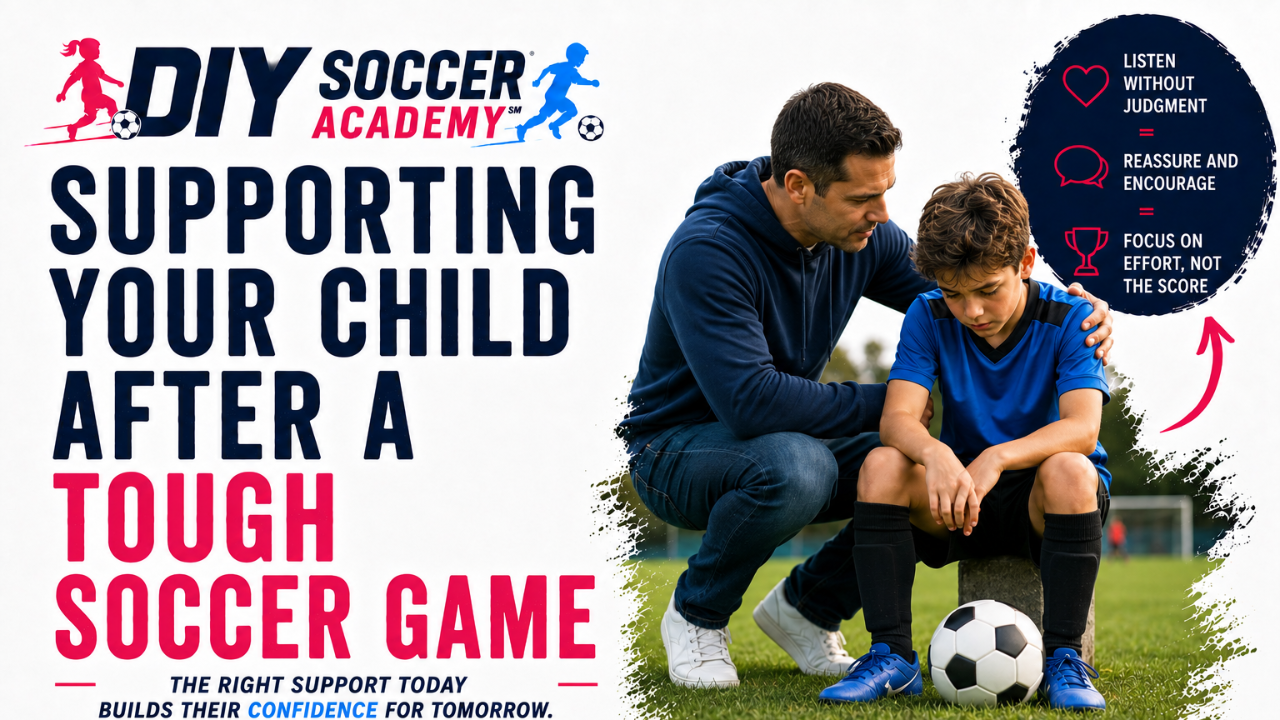
Supporting Your Child After a Tough Soccer Game
Published by DIY Soccer Academy
Every soccer player has tough games.
They miss an open shot. Give the ball away. Lose a game they expected to win. Spend more time on the bench than they wanted. Make a mistake that leads to a goal.
For parents, those moments can be difficult to watch.
You want to help. You want to make your child feel better. And sometimes, you may even feel frustrated yourself.
But what your child needs most after a tough game usually isn't a detailed analysis of what went wrong.
They need to know they're supported.
How you respond after a difficult game can have a lasting impact on your child's confidence, mindset, and relationship with soccer.
First, Remember: It's Their Game
As parents, it's easy to become emotionally invested in our child's performance.
You spend time driving to practices, buying equipment, watching games, and supporting their training. Naturally, you want to see them succeed.
But soccer ultimately belongs to your child.
Their mistakes, losses, missed opportunities, and difficult games are all part of their development.
Your job isn't to make every difficult experience disappear.
Your job is to help them learn how to handle it.
Give Them a Moment
Immediately after a tough game, your child may not want to talk about soccer.
That's okay.
They may be frustrated, embarrassed, disappointed, or simply exhausted.
Instead of immediately asking:
"What happened?"
"Why didn't you pass?"
"Why weren't you more aggressive?"
Give them some space.
A simple:
"I know that was tough. I'm proud of you."
may be all they need to hear.
Let them decide when they're ready to talk.
Don't Turn the Car Ride Home Into a Film Session
The ride home can be one of the most important moments after a game.
It's also one of the easiest places for parents to accidentally create pressure.
You may have noticed things your child didn't.
You may know exactly what they could have done differently.
But immediately breaking down every mistake can make a difficult experience even harder.
Your child probably already knows they made mistakes.
Instead, use the ride home to help them decompress.
Talk about something unrelated to soccer.
Ask what they want to eat.
Play their favorite music.
Let them relax.
There will be plenty of time to learn from the game later.
Focus on the Person, Not the Performance
Your child needs to know that their value isn't determined by how they played.
A bad game doesn't make them a bad player.
And one great game doesn't make them a great player.
Try to separate the player from the performance.
Instead of:
"You didn't play very well today."
Try:
"Today was difficult, but that's part of learning."
Instead of:
"You need to work harder."
Try:
"What do you think you could work on next?"
This helps your child understand that performance can change while their worth remains constant.
Avoid the Blame Game
After a difficult loss, there can be a temptation to identify who was responsible.
Maybe the referee made a bad call.
Maybe a teammate didn't pass.
Maybe the coach made a decision you disagreed with.
Maybe your child made a mistake.
Trying to assign blame rarely helps your child develop.
Instead, help them focus on what they can control.
They can control:
- Their effort
- Their attitude
- Their preparation
- Their response to mistakes
- Their willingness to learn
- Their commitment to practice
They can't control every decision, every teammate, every referee, or every outcome.
Teaching your child that difference is an important part of developing mental toughness.
Ask Better Questions
Once your child has had some time to process the game, you can help them reflect.
Instead of immediately giving advice, ask questions.
Try:
"How did you feel about the game?"
"What do you think went well?"
"What was the most difficult part?"
"Was there anything you learned?"
"Is there something you'd like to work on?"
These questions encourage your child to think for themselves.
You're not telling them what they should have done.
You're helping them discover it.
Help Them See the Bigger Picture
One game doesn't define a player's development.
Youth soccer is a long-term journey.
There will be great games.
There will be frustrating games.
There will be moments where everything seems to click.
There will be moments where nothing seems to work.
That's normal.
A young player who learns how to respond after a tough game develops something much more valuable than the ability to avoid mistakes.
They develop resilience.
And resilience is built by experiencing setbacks and learning how to move forward.
Don't Force a Positive Spin
Sometimes parents try so hard to make their child feel better that they immediately say:
"Don't worry about it!"
"You played great!"
"It wasn't that bad!"
Even when the child knows it was a difficult game.
You don't have to convince your child that everything was perfect.
It's okay to acknowledge reality.
You can say:
"Yeah, that was a tough one."
Then follow it with:
"But one tough game doesn't define you. We'll keep working."
That response validates their feelings without allowing disappointment to become their identity.
Encourage Them to Learn, Not Dwell
There's a difference between reflection and dwelling.
Reflection asks:
"What can I learn from this?"
Dwelling asks:
"Why did I play so badly?"
One moves the player forward.
The other keeps them stuck.
Help your child turn frustration into something productive.
Maybe they struggled with their first touch.
Maybe they weren't comfortable using their weak foot.
Maybe they had difficulty dribbling under pressure.
Maybe they need to improve their fitness or decision-making.
Whatever the challenge, identify one area to work on.
Then move forward.
Use Training as a Positive Outlet
A tough game can sometimes reveal an area where your child needs more practice.
That's an opportunity—not a punishment.
If your child struggled with their weak foot, spend some time working on it.
If their first touch was inconsistent, dedicate a few minutes to ball control.
If they struggled with dribbling, practice changes of direction and close control.
The key is to keep the training purposeful and positive.
Don't say:
"You played badly, so now you have to practice."
Instead:
"You mentioned wanting to get better at your weak foot. Let's work on it together."
That changes training from punishment into progress.
Celebrate the Courage to Keep Going
Sometimes the biggest victory after a tough game isn't a goal or an assist.
It's getting back out there.
It's trying again after making a mistake.
It's continuing to ask for the ball.
It's practicing a skill that didn't go well.
It's showing up to the next practice with a positive attitude.
Those are the moments parents should notice.
Tell your child:
"I love how you kept trying."
"I'm proud of how you responded."
"Let's keep working."
These messages teach your child that persistence matters.
Don't Compare Them to Other Players
After a tough game, avoid comparisons.
Don't say:
"Why can't you play like that player?"
Or:
"Your teammate is much more aggressive than you."
Every player develops at a different pace.
Comparisons can make children feel like they're falling behind when they may simply be on a different development timeline.
Instead, compare your child to themselves.
Ask:
"Are you better than you were a few months ago?"
That's the progress that matters.
Remember That Confidence Is Built Over Time
Confidence doesn't mean your child always believes they're the best player on the field.
Real confidence is believing:
"I can make a mistake and keep going."
"I can struggle with something and improve."
"I don't have to be perfect."
"I can handle a difficult game."
That's the kind of confidence that helps young players continue developing.
And parents play an enormous role in building it.
What Parents Can Say After a Tough Game
Sometimes you simply don't know what to say.
Here are a few simple phrases that can help:
"I know that was tough."
"I'm proud of your effort."
"It's okay to be disappointed."
"One game doesn't define you."
"What do you think you learned?"
"What would you like to work on?"
"We'll keep working."
"I'm always proud to watch you play."
Notice that none of these statements require you to analyze the game.
They simply remind your child that they're supported.
The Bigger Lesson
Soccer will teach your child many technical skills.
They'll learn how to dribble, pass, shoot, control the ball, defend, and make decisions.
But some of the most important lessons happen after things don't go according to plan.
How do they respond to disappointment?
Can they learn from mistakes?
Can they keep practicing?
Can they stay confident when things aren't going well?
Can they come back the next day and try again?
Those lessons extend far beyond soccer.
Your Child Doesn't Need a Perfect Game
Your child doesn't need to play perfectly.
They don't need to score every game.
They don't need to win every game.
They don't need to avoid mistakes.
They need opportunities to practice, struggle, learn, and improve.
And they need to know that their parents will be there through all of it.
So after the next tough game, resist the urge to immediately coach.
Take a breath.
Give your child some space.
Listen.
Encourage them.
And when they're ready, help them identify the next step forward.
Because the goal isn't to raise a player who never has a bad game.
It's to help raise a player who knows how to respond when they do.
Keep Their Development Moving Forward
At DIY Soccer Academy, we believe young players improve through consistent, purposeful practice—not pressure.
Our structured training programs give players simple, focused sessions they can complete at home, helping them build technical skills, confidence, and consistency over time.
Because one tough game is just one moment in a much bigger player development journey.
Best SEO FAQs
1. What should I say to my child after a bad soccer game?
Start by acknowledging that the game was difficult and let your child know you're proud of their effort. Avoid immediately analyzing mistakes. Simple statements like, “I know that was tough,” or “I'm proud of you for continuing to work,” can help your child process the experience.
2. How do I encourage my child after a soccer loss?
Focus on effort, learning, and what your child can control rather than the final score. Help them understand that losses are a normal part of youth soccer and can provide opportunities to learn and improve.
3. Should I talk to my child about their mistakes after a soccer game?
Give your child time to cool down before discussing mistakes. When they're ready, ask questions such as, “What do you think you learned?” or “Is there something you'd like to work on?” This encourages reflection without making the conversation feel like criticism.
4. How can I help my child build confidence after a bad soccer game?
Remind your child that one game doesn't define them as a player. Praise effort, persistence, and improvement rather than focusing only on goals, assists, or winning. Encourage them to continue practicing and give them opportunities to experience small successes.
5. Should parents coach their child after a soccer game?
Parents generally don't need to become the coach after a game. Let the coach handle technical and tactical feedback while you focus on encouragement, emotional support, and helping your child maintain a positive attitude toward development.
6. What should I do if my child is upset after losing a soccer game?
Give them space to process their emotions and let them know it's okay to be disappointed. Listen without immediately trying to fix the situation, then help them focus on what they can learn and control going forward.
7. How can I help my child learn from a tough soccer game?
Once your child has had time to process the game, ask what they thought went well, what was difficult, and what they would like to improve. Choose one specific area to work on rather than focusing on every mistake.
8. How can soccer parents support player development without adding pressure?
Parents can support development by creating opportunities to practice, encouraging consistency, celebrating progress, and allowing their child to make mistakes. The goal is to support the player without making every practice or game about performance.