When Should My Child Move from Recreational Soccer to Club Soccer?
Aug 08, 2026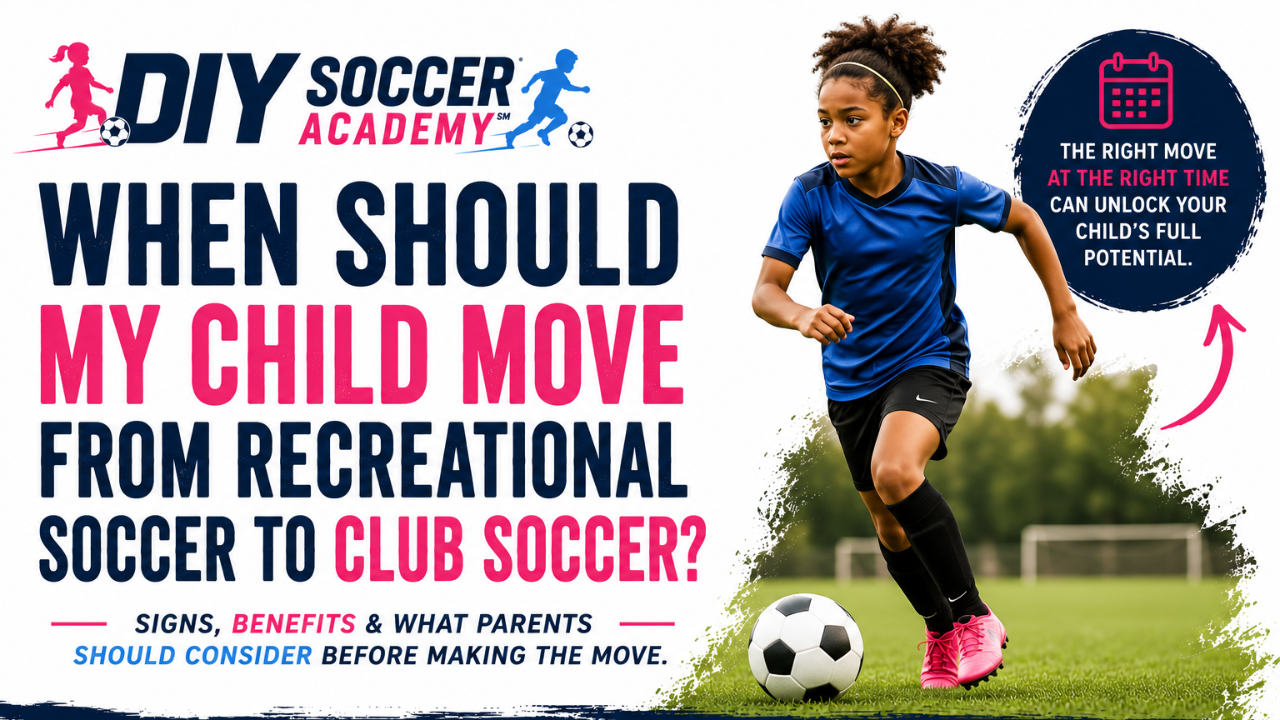
When Should My Child Move from Recreational Soccer to Club Soccer?
Published by DIY Soccer Academy
One of the biggest questions soccer parents ask is:
"Is my child ready for club soccer?"
It's an exciting milestone, but it can also feel overwhelming.
Many parents worry they'll make the move too early.
Others wait too long and wonder if their child is falling behind.
The truth is, there isn't one perfect age to move from recreational soccer to club soccer.
Instead, the right time depends on your child's skills, maturity, motivation, and goals.
In this guide, we'll help you recognize the signs that your child may be ready for the next step.
Recreational Soccer vs. Club Soccer
Before deciding when to make the transition, it's important to understand the difference.
Recreational Soccer
Most recreational programs focus on:
- Having fun
- Learning the basic rules
- Building friendships
- Introducing fundamental skills
- Equal playing time
The goal is helping children enjoy the game while developing a foundation.
Club Soccer
Club soccer typically involves:
- Higher competition
- More structured coaching
- Greater training expectations
- Additional practices
- Increased travel
- More commitment from players and families
Club soccer isn't "better."
It's simply designed for players who are ready for more challenge and development.
Signs Your Child May Be Ready for Club Soccer
No single skill determines readiness.
Instead, look for several of these indicators.
They Love Practicing
One of the strongest signs has nothing to do with talent.
It's enthusiasm.
Does your child:
- Ask to practice at home?
- Watch soccer in their free time?
- Enjoy learning new skills?
- Play soccer just for fun?
Children who genuinely enjoy practicing usually thrive in more competitive environments.
Motivation matters more than pressure.
They're Comfortable with the Ball
Before moving into club soccer, players should have confidence performing basic technical skills.
These include:
- Dribbling under control
- Passing accurately
- Receiving the ball
- Basic ball mastery
- Turning
- Using both feet (at least occasionally)
They don't need to be perfect.
They simply need a solid technical foundation.
They Want More Challenge
Some children naturally reach a point where recreational soccer no longer pushes them.
You might notice they:
- Stand out during games
- Seek tougher competition
- Become eager to learn more advanced skills
- Ask questions about improving
These are healthy signs they may benefit from a more competitive environment.
They're Coachable
Technical ability matters.
But attitude matters even more.
Players who succeed in club soccer are willing to:
- Listen to feedback
- Try new ideas
- Learn from mistakes
- Work hard during practice
- Stay positive
Coaches can teach skills.
They can't teach willingness to improve.
Skill Benchmarks to Consider
Parents often ask:
"Does my child need to be one of the best players on their recreational team?"
Not necessarily.
Instead, ask whether they can consistently perform the fundamentals.
A player preparing for club soccer should be developing confidence in:
✅ Ball mastery
✅ Dribbling with both feet
✅ Passing and receiving
✅ First touch
✅ Basic 1v1 moves
✅ Turning under control
✅ Understanding simple game concepts
These skills create the foundation for success at higher levels.
Emotional Readiness Is Just as Important
Many parents focus only on soccer ability.
But emotional maturity often determines whether children enjoy club soccer.
Ask yourself:
Can they handle constructive coaching?
Do they recover after making mistakes?
Can they stay positive after losing?
Do they enjoy competition?
Can they balance soccer with school and family life?
A player who is emotionally ready will usually adapt much more successfully than one who simply has advanced technical skills.
Is My Child Ready for More Competition?
Competition isn't something children should fear.
It should inspire them.
If your child sees stronger competition as an opportunity to improve—not something to avoid—they're developing a healthy mindset.
Remember:
Club soccer isn't about proving you're already great.
It's about continuing to grow.
Understanding the Financial Commitment
Club soccer can be a significant investment.
Costs may include:
- Registration fees
- Uniforms
- Tournament fees
- Travel
- Equipment
- Team events
- Additional training
Before making the jump, consider whether your family is comfortable with both the financial and time commitments.
The best soccer environment is one that supports your child without creating unnecessary stress for your family.
Remember: Club Soccer Isn't the Only Path to Improvement
One of the biggest misconceptions in youth soccer is that joining a club automatically creates better players.
The truth is:
Players improve because of quality coaching, purposeful practice, and consistent repetition—not simply because they wear a different jersey.
Many young athletes dramatically improve by combining team practices with structured individual training.
Confidence, technical ability, and consistency can all be developed before—and after—joining a club team.
How DIY Soccer Academy Helps Players Prepare
Whether your child is planning to stay in recreational soccer or hoping to join a competitive club, individual development remains one of the most important parts of the journey.
DIY Soccer Academy helps players build the technical foundation needed to succeed through:
- Expert coaching
- Progressive skill development
- Structured daily training
- Ball mastery
- First touch
- Dribbling
- Passing
- Weak foot development
- Confidence-building exercises
With just 15 minutes of purposeful practice each day, players arrive at team practices more prepared, more confident, and ready to continue improving.
Final Thoughts
So, when should your child move from recreational soccer to club soccer?
The answer isn't based on age alone.
It's based on readiness.
When your child:
- Loves practicing
- Has developed strong fundamentals
- Wants greater challenges
- Is emotionally prepared
- Can commit to the additional responsibility
They may be ready to take the next step.
But remember:
Club soccer isn't the finish line.
It's simply another stage in a player's development.
The most successful young athletes continue improving because they train consistently, stay curious, and build confidence one session at a time.
Ready to Help Your Child Prepare for the Next Level?
Whether your child's goal is making their first club team, earning more playing time, or simply becoming more confident with the ball, DIY Soccer Academy provides a clear player development pathway designed to help them grow at every stage.
🌱 Foundation Academy helps young players master the fundamentals and build confidence.
⚽ Select Academy develops stronger technical skills, greater consistency, and prepares players for more competitive environments.
🏆 Elite Academy is designed for ambitious athletes pursuing the highest levels of youth soccer.
🎯 Private Coaching Experience provides personalized coaching and feedback tailored to each player's unique goals.
Because the journey to club soccer—and beyond—begins with purposeful practice, consistent development, and confidence built one session at a time.
FAQ Section
What age should a child start club soccer?
There isn't one correct age. Many players transition between ages 8–12, but readiness depends more on skill development, motivation, emotional maturity, and family commitment than age alone.
How do I know if my child is ready for club soccer?
Players are often ready when they consistently demonstrate strong fundamentals, enjoy practicing, seek greater challenges, respond well to coaching, and are excited to improve.
Does my child need to be the best player on their recreational team?
No. A player doesn't need to dominate recreational soccer before moving to club. Strong fundamentals, a willingness to learn, and a positive attitude are more important than being the top scorer.
Is club soccer worth the cost?
Club soccer can be a valuable investment for families whose children are motivated to train and compete at a higher level. Consider both the financial commitment and your child's long-term interest before making the decision.
Can my child prepare for club soccer at home?
Yes. Consistent individual training at home helps young players improve ball mastery, passing, first touch, dribbling, and confidence—all of which support success at the club level.
Recreational soccer compared to club soccer.
| Recreational Soccer | Club Soccer |
|---|---|
| Focus on fun and learning | Focus on development and competition |
| Equal playing time | Playing time often based on performance, effort, and team needs |
| 1–2 practices per week | Typically 2–4+ practices per week |
| Local competition | Higher-level competition and tournaments |
| Lower financial commitment | Higher investment in training, travel, and fees |
| Great for beginners | Best for motivated players seeking additional challenge |